Comments
Header
News from Shin Kaze
July 2026
Shin Kaze Aikido Alliance is an organization dedicated to the practice and development of
Aikido. It aims to provide technical and administrative guidance to Aikido practitioners and
to maintain standards of practice and instruction within an egalitarian and tolerant structure.
|
|
Conten
Intro
Introduction

Welcome to the July 2026 edition of the Shin Kaze Aikido Alliance Newsletter!
This issue brings together a rich tapestry of reflections, updates, and milestones from across our international community.
Our contributors explore deep technical and philosophical concepts—reassessing the nature of force, analyzing conflict
through both a martial and human lens, and examining the Japanese concept of constant readjustment. We journey from Prague,
where a Cuban instructor illustrates how our art transcends cultural boundaries, to Peru, where the meditative repetition
of Jo practice dissolves the self.
We also look closely at the dynamics of the dojo itself: how senior students can say less to help more, the role of daily
self-challenge in overcoming complacency, and the deeper synthesis of combat capability with non-confrontation. Alongside
these insights, we feature lighter creative works like the Aikido Animals comic, a poignant update on how Aikido supports
mental and physical health amidst wartime hardships in Ukraine, and an inspiring journey of establishing a new dojo in
Venezuela. Finally, we celebrate the growth of our global family by welcoming new provisional member dojos from Colombia
and Venezuela, and honoring practitioners from the US, Venezuela, Argentina, and Ukraine who recently received advanced
black belt promotions.
This publication serves as an open forum where aikidoists worldwide unite to chronicle their journeys, debate concepts,
and articulate unique points of view. While distance keeps us away from a common training mat, these pages bridge the gap,
allowing us to swap breakthroughs and ignite each other's passion. May these insights fuel your dedication and bring you
closer to the international Shin Kaze community. We invite you to write about your own path; your stories are the vital
thread helping keep our global Aikido family connected.
|
|
Art. 2
Force: A Necessary Reassessment
By Leandro Ernesto Obligado
Dojo-cho, Santiago del Estero Aikikai, Argentina
"Force or non-force, that is the question."
What is force?
In physics, force is defined as any interaction capable of modifying the state of motion of a body or producing a deformation.
From a biomechanical standpoint, force can be understood as the capacity to generate muscular tension to produce, control, or resist an action.
In physiology, force can be defined as the ability of the neuromuscular system to generate tension and produce mechanical work.
Up to this point, the definitions seem clear enough.
Force is present in the human body.
Force is present in every physical action.
Force is part of our relationship with the world.
Force and health
Curiously, while force is often viewed with a certain degree of suspicion in some martial circles, current science considers it one of the most important physical capacities for health.
The progressive loss of strength is associated with a higher risk of falls, fractures, loss of independence, and mortality.
We also know that strength training helps preserve cognitive functions such as memory and is part of the recommended strategies to reduce the risk of neurodegenerative conditions like Alzheimer's disease.
Of course, the goal of Aikido is not to develop muscle strength for its own sake.
However, this knowledge reminds us that force accompanies us throughout our entire lives.
Force and learning
All learning begins with limited resources.
When a child learns to eat, they use their hands before mastering utensils. They get messy, squeeze too hard, spill, and experiment. No one would think of handing them fine cutlery before they discover for themselves how to feed themselves.
Perhaps something similar happens with force.
When a beginner arrives at the dojo, they try to resolve the problems posed by a technique using the resources they possess. They use their arms, tense their body, push, pull, and seek results through sheer effort.
Simply because that is the starting point of their learning.
Force then appears as one of the first available resources to execute a technique.
Force and practice
It is striking that, in some conversations about Aikido, force occupies an uncomfortable place.
The history of our art shows something different.
For generations, practitioners dedicated countless hours to practice and bukiwaza.
It was not solely about learning techniques.
They were also developing strong, resilient, and functional bodies.
Force did not seem to be a problem.
It was a natural part of training.
Perhaps the question was never whether force should exist within the practice or not.
Force was already there.
The real question seems to be what we do with it.
With years of practice, something changes.
The practitioner begins to better understand their body, their base, their balance, and the way they transmit forces through their physical structure.
Feet, legs, hips, torso, arms, gaze, and breathing begin to align and integrate into a single action.
The integration of the kinetic chain allows body segments that previously acted in isolation to begin functioning as a unit.
From a physical and biomechanical perspective, this does not necessarily imply a reduction in force.
On the contrary, it often allows it to be transmitted more efficiently.
What changes is not just the amount of force used, but the way it is organized and expressed.
Force and non-force
Up to this point, we have defined force from physics, biomechanics, and physiology.
Force is present in displacement.
Force is present in unbalancing.
Force is present in throwing.
When we watch an advanced master, we often say they are not using force.
However, what we observe seems difficult to explain solely in terms of force.
Could non-force be the epilogue of a long path of practice that began, like so many others, by using force?
Conclusion
After all, when we look at a great master and say they are not using force, what are we really seeing?
Force is present in the beginner.
Force is present in the experienced practitioner.
Force is present in the master.
What changes is the way it is organized, transmitted, and expressed.
And if force is present in every physical interaction, what do we mean by non-force?
That remains the question.
|
|
Art. 3
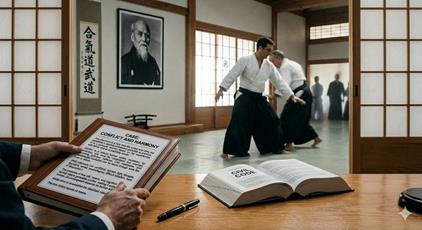
The reality of conflict
By: Luis Suárez
Venezuela Aikido Kokyu Ho Dojo, Maracay, Venezuela
Author’s Note
What is described below does not constitute a philosophical postulate or an absolute premise intended to impose changes upon the common understanding of conflict. Nor does it aspire to establish a theoretical progression founded upon doctrinal figures or academic authorities for the purpose of achieving argumentative validation. Further still, it does not seek to institute an irreducible dogma that must be blindly believed.
That being said, the account set forth here simply reflects my own capacity for perception, within the essential framework of Aikido, its sphere of tangibility as developed within the Dojo, and my personal experiences. It is merely a personal opinion, grounded in my modest experiences surrounding Budo and my professional practice as an attorney.
Through these experiences, I have come to understand that litigating, struggling, debating, confronting, and ultimately engaging in conflict should be perceived as a normal aspect of human activity, necessary for its evolution, born from coexistence, and whose recurrence through time is inexorably guaranteed. For this reason, turning to conciliatory tools such as those proposed by Law or Aikido becomes an indispensable exercise for calming the turmoil that arises from struggle, distancing ourselves from primitive violence, and drawing closer to a sustainable civility.
According to the Dictionary of the Royal Spanish Academy (RAE), the word conflict has the following meanings:
CONFLICT, From the Latin conflictus.
Combat, struggle, fight. Also used in a figurative sense. Armed confrontation. Distress; an unfortunate situation that is difficult to resolve. Problem, issue, subject of discussion. Conflict of authority or jurisdiction. Psychology. Coexistence within the individual of contradictory tendencies capable of generating anxiety and neurotic disorders. Obsolete. The moment in which battle is most fierce and violent.
At first glance, the word "conflict" clearly carries an apparent negative connotation that distorts the actions of the individual subjected to its interaction. It may involve an individual state or bring together a plurality of entities, creating an environment of hostility or threat.
When we focus on its origin, conflict emerges in a state of adversity whose genesis is undeniably human. Man gives rise to its appearance and brings together within its purpose aspirations and desires belonging to his own sphere, being antagonistic to any condition derived from nature. Within the animal kingdom, for example, the term conflict does not apply, since within its structure the interacting entities occupy a defined space and fulfill a specific role.
In this way, predator and prey coexist in an unquestionable manner, distinguishing themselves not only in morphology, strength, or evolutionary condition, but also in the place they occupy within their environment, being mutually essential in perfect harmony. When prey is hunted, it does not, strictly speaking, experience a state of conflict; rather, it processes the alternatives available to it according to its natural role and position within a broader chain: to flee or to be consumed. For its part, the predator fulfills its function by satisfying its need for nourishment through hunting, but does not exceed its capacity to accumulate food beyond its own necessity. It is an organic function common to both, and therefore their interaction is limited solely to the fulfillment of inherent needs.
Thus, it should be considered erroneous to use the term "conflict" to describe the interaction between the aforementioned subjects, since the pre-established order of natural harmony prevails over any other possibility. To assert otherwise would be to claim that a herbivorous prey animal, for example, when eating a plant (another living being within an ecosystem), would be entering a state of imminent conflict each time it attempts to satisfy its nutritional needs—an idea that is not immediately consistent with common understanding.
Therefore, we can state that conflict arises exclusively within a human context, inherently involving free will, reasoning, and cognition, producing various motivations that trigger its existence, whether or not there is a clear justification for it. It must be concluded that conflict is an event associated with human beings, and its resolution clearly entails a framework that is intrinsic to them.
Given this assertion, conflict persists insofar as human beings generate its appearance, and it fades when they distance themselves from their own disturbances. It is somewhat contradictory to conceive of a conflict-free daily existence; however, understanding that human nature is what generates its etiology makes it easier to identify apparent solutions for addressing any disagreement. Just as with art—while clearly maintaining the necessary distinctions—conflict arises from a human expression, and its manifestations are diverse; therefore, the ways or methods of addressing it are equally varied.
Once the previous premise has been established—namely that conflict is a product of human beings—it becomes necessary to examine the stages of its formation and deepen our understanding of it.
In this regard, we find that fatality or an overriding order emerges as the determined consequences of conflict, giving rise to three structures of perception: the Self, the Other, and the Shared. However, in all these scenarios, conflict contains an inherent element: the human interest in allowing it to develop and persist over time.
First, when conflict manifests as a disturbance of the Self and when it arises internally, its appearance is structured through situations managed by the individual himself. In these conditions—namely adverse internal states—the path to resolving conflict lie in the individual’s capacity to foster growth and transformation. Thus, adversity, depression, emotional opacity, frustration, anxiety, prejudice, among others, become catalysts of internal conflict, whose emergence opens the possibility of weakening the will to overcome them.
For example, the perception of ukemi for a new practitioner varies significantly depending on age. While for a younger beginner ukemi may be perceived as a pleasant challenge that tests physical ability, for an older student it may become a source of fear rooted in the possibility of injury or harm affecting daily life and mobility. In this latter case, the conflict arises from the individual confronting the new circumstance, and the disturbance is essentially self-generated. It is enough for the individual to accept the true nature of ukemi (integration into the fall), understand that its learning process is gradual and structured, and recognize that ukemi is intended to protect rather than harm; in short, the individual must assume the difficulty he himself has created, thereby elevating a state of harmony as Aikido truly reflects it. By dissolving these internal disturbances, conflict is transformed into an opportunity for growth and ceases to be an internal enemy. The conflict disappears.
Regarding the second scenario, the external, conflict arises as a reflection imposed by another subject who seeks to negatively obscure the energy of another. In this one-directional stage, the individual upon whom the conflict is projected has the complex task of inhibiting it, of not becoming involved.
In this circumstance, behavior must be directed toward avoiding participation in the projected conflict. It is not about resisting or adopting a victim stance, nor about becoming an adversary; rather, it is about flowing with the opposing energy until a state of stillness is achieved. How can this be done? By practicing Musubi—that is, integrating oneself into the negative action without the need to apply equal or greater force. The focus shifts away from confrontation or subjugation, and instead seeks to transform antagonistic energy, channeling the condition of struggle toward a new state of balance. This elevates conflict to a reflective level, neutralizing basic principles (every action generates a reaction) that would otherwise fuel hostility.
The fundamental idea of this stage, from a martial arts perspective, would be to limit the action of the opposing subject rather than launching them away with a nage. If someone pushes you, there is no need to resist or evade; instead, one enters into the attack in order to dissolve it (Irimi). There is no opposition or blocking—only total adaptation from structure.
Finally, we encounter the stage in which conflict contains a shared component. The subjects involved in the confrontation seek, with strong determination, to impose their power by force, pursuing their objectives through coercion. Any conscious or rational effort is set aside in favor of more emotional and biased behavior. One becomes part of the conflict as an active element, leading toward a fatal outcome.
At this point, even if a "victor" appears to exist, the reality of the situation implies extensive harm that affects all parties involved. The deep entanglement of interests and their imposition opens the door to reciprocal damage that is not easily overcome. It may even generate an abject cycle in which repeated vengeance becomes central. The community of conflict at this stage operates under the measurement of force, dissolving equality and prioritizing direct confrontation. It is governed by the principle of "the law of the strongest," interpreted as a true reflection of natural order. Nothing could be further from what nature, as previously stated, truly represents: a correlation of entities arranged within an environment with a defined purpose and function.
From the conceptual perspective of Aikido, this approach would be the least appropriate, as it departs from its fundamental essence as a martial art—namely, the restoration of the natural order of the universe disturbed by conflict.
The world, or our daily reality, cannot—and perhaps should not—exist without conflict. The plurality of visions, beliefs, principles, and doctrines inevitably generates divergence among individuals in any community. However, through the integration of Aikido, we may approach conflict from a different perspective: more open, less personal, more rational, structured, and balanced.
Aikido does not propose a set of techniques to fight or defeat an enemy. It points instead toward a path of reconciliation with the world and the formation of a human family. Every encounter, whether on the tatami or in life, becomes an opportunity to transform conflict into connection, force into harmony, and the "I" into "WE". Through practice, one does not merely learn self-defense, but comes to understand that true victory is one that leaves no losers.
"Very often, inexperienced practitioners criticize the softness of Aikido movements, comparing them to a dance. In reality, they are reflecting their own conceptions of the martial way. Stereotyped images of conflict and struggle dominate their minds. For them, strength is synonymous with collision, and they only recognize the simplest forms of attack. Does the moon collide with the Earth? Does the Earth challenge Mars or Jupiter? Their prejudices block acceptance of the truth. Their hostility blocks the development of true power." (Saotome Mitsugi, *Aikido and the Harmony of Nature*, p. 163) |
|
Art. 4
Aikido Training in the Old Continent
By Leonel Sánchez Sotolongo Fukushidoin
Dojo-cho Kan Sho Ryu Dojo, Cuba
Due to work commitments, I once again had the opportunity to travel to Europe. This time, my
destination was Prague, Czech Republic, a charming city that captivates visitors with its history,
architecture, and the unique atmosphere found throughout its streets.
As is my custom whenever I travel, the first thing I pack is my keikogi. I always look forward to
finding a dojo where I can practice Aikido, convinced that this art transcends borders and languages.
On this occasion, thanks to modern technology that makes communication so much easier, I was able to
get in touch with Ales Hruska Sensei, Dojo-cho of Aikido v Centru Dojo, who very kindly invited me to
participate in his classes.
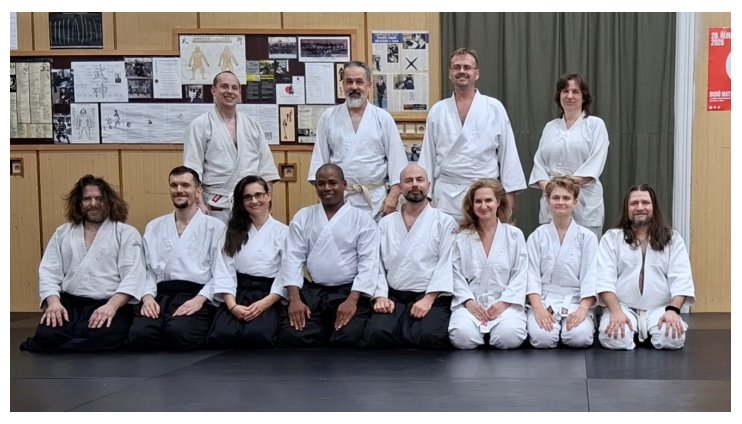 After a long 31-hour journey from Cuba and with only four hours of rest, I attended my first practice.
From the very beginning, I was warmly welcomed by Sensei Ales and all the members of the dojo, who made
me feel completely at home.
After a long 31-hour journey from Cuba and with only four hours of rest, I attended my first practice.
From the very beginning, I was warmly welcomed by Sensei Ales and all the members of the dojo, who made
me feel completely at home.
The practice was intense, dynamic, and carried out with great technical precision. Beyond cultural
differences or language barriers, once the class begins, the language of Aikido becomes universal.
Every bow, every technique, and every fall reflects the same principles of respect, harmony, and continuous
self-improvement that we aikidoka share around the world.
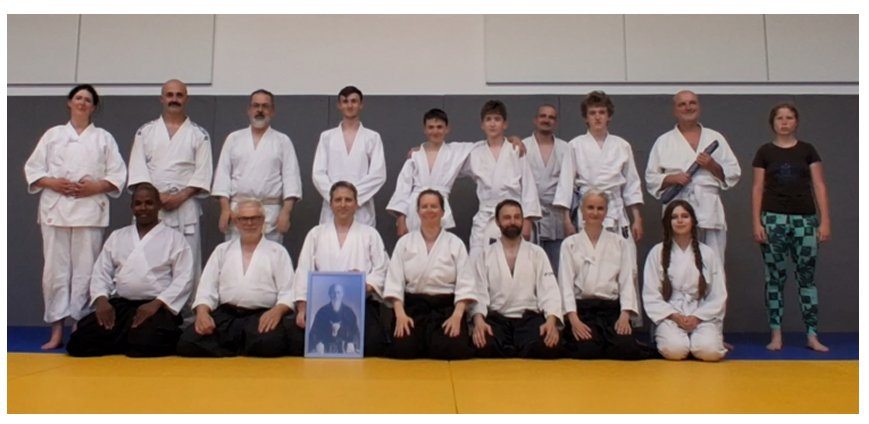 During my stay in Prague, I also had the opportunity to train at Sekai Dojo, led by Otakar Horejš Sensei,
5th Dan Aikikai, which follows the legacy of Hiroshi Tada Sensei. This experience allowed me to meet
another community of practitioners and appreciate different approaches to teaching, while always preserving
the essence of Aikido. It was enriching to see how each dojo maintains its own identity without losing sight
of the fundamental principles of this art.
During my stay in Prague, I also had the opportunity to train at Sekai Dojo, led by Otakar Horejš Sensei,
5th Dan Aikikai, which follows the legacy of Hiroshi Tada Sensei. This experience allowed me to meet
another community of practitioners and appreciate different approaches to teaching, while always preserving
the essence of Aikido. It was enriching to see how each dojo maintains its own identity without losing sight
of the fundamental principles of this art.
These experiences reaffirm that traveling with a keikogi in your suitcase is always worthwhile. Every dojo
I visit provides an opportunity to learn new technical perspectives, deepen my practice, and, above all,
build friendships with people who share the same passion.
|
|
Art. 5
The Jo and Forgetting Oneself
By Juan Carlos Delgado
Dojo-cho, Dojo Himawari – Lima, Perú
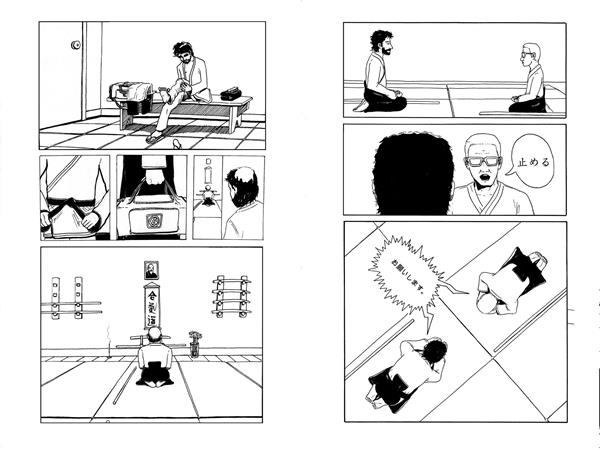
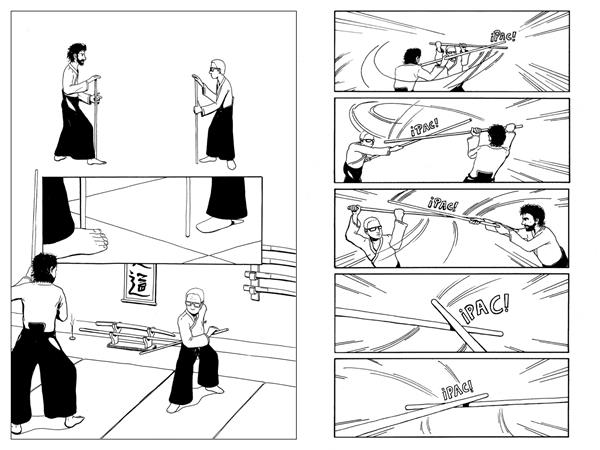
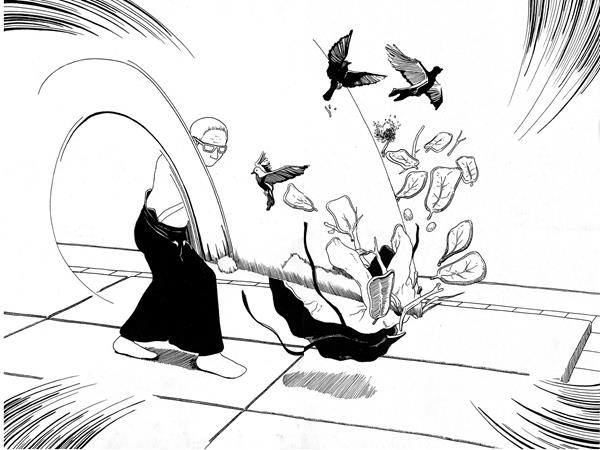
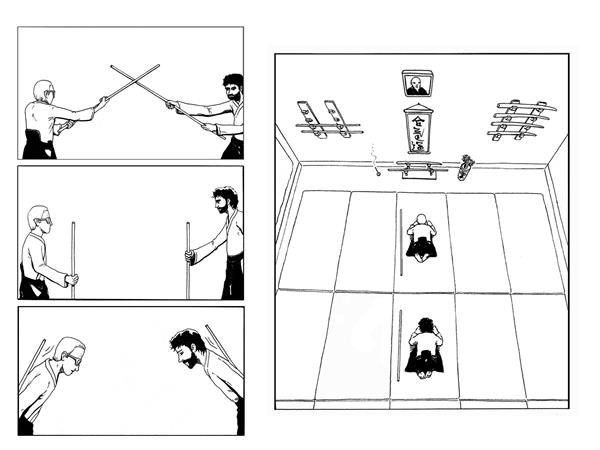
The images I share here are part of I Only Make Comics – Vol. II,
a work I published in 2017 through my publishing house, Mágica Ediciones, which brought together short stories
related to mystical inquiry and inner experience.
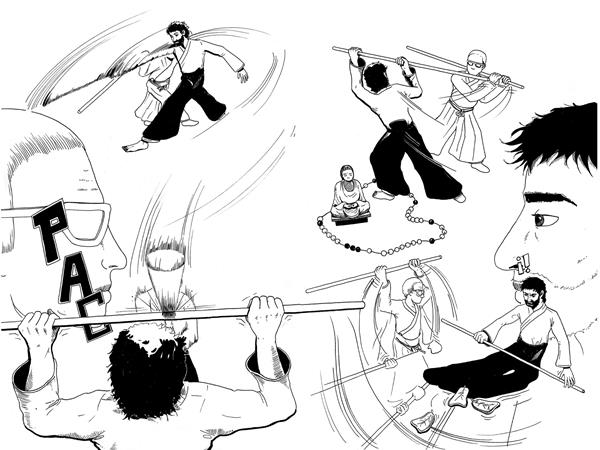
In this case, I wanted to explore a feeling I have encountered in the practice of the Jo and that perhaps other
practitioners may also recognize: those moments where we seem to forget ourselves a little.
Through repetition, movement, breathing, and attention, something changes. For brief moments, the inner noise
quiets and we stop being so preoccupied with ourselves. The body moves, the practice continues, and a feeling
emerges that is difficult to describe: as though one were fully present and, simultaneously, absent
from that everyday notion of the “self.”
I do not intend to offer an explanation, but rather to share an impression born from practice. Perhaps some will
see themselves reflected in it; perhaps others will interpret it differently. In any case, I hope these illustrations
can serve as a small invitation to observe training also from that more intimate and quiet space that sometimes
appears along the path of Aikido.
Warm greetings from Lima, Peru.
|
|
Art. 6
Saying Less - Helping More
By Ralph Legnini Shidoin
Dojo-cho Art of Peace Aikido, Stone Ridge, NY
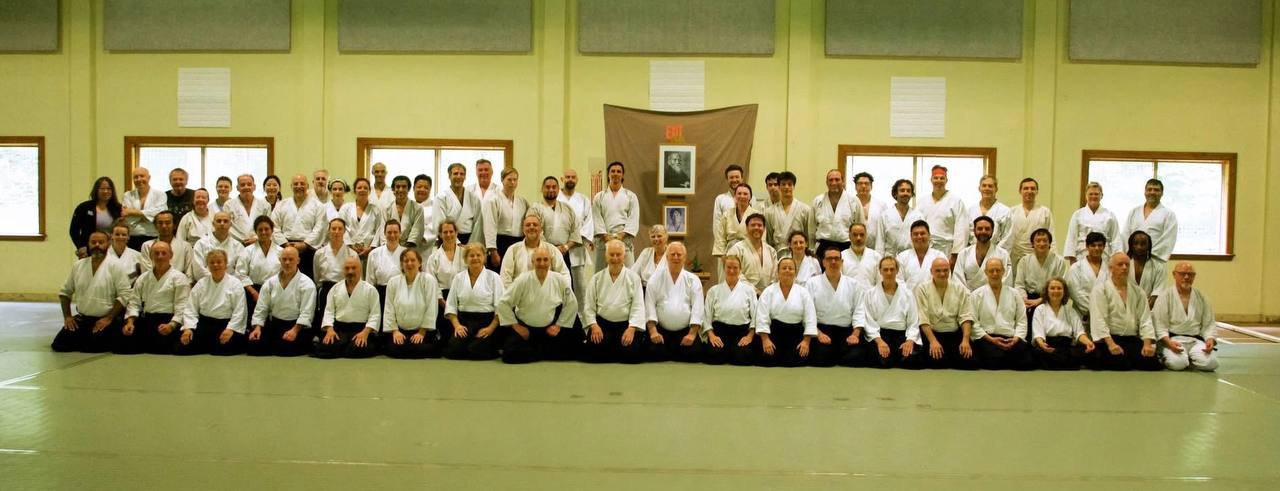
I recently taught at and participated in the 2026 Kanai Sensei Memorial Seminar.
It was a wonderful weekend, and it was great to see old friends and make new ones as well.
One thing stood out in my mind afterward. During one of the classes, I paired up with a kyu student. The technique was Ryotedori Tenchinage.
Now here’s the thing—I have very often seen senior students bombard others with an abundance of instruction when training together. They mean well for the most part, but for a less experienced student, it can be overwhelming and simply too much to take in. It also frequently turns into a lot of talking. Sometimes, the senior student starts doing it immediately, even during or right after the very first repetition.
As a musician, I know one does not learn to play their instrument by having a teacher talk to them about everything they should be doing. They learn mostly from repetitions—playing the song, the riff, the scale, or the chord progression over and over and over again. It is also not helpful to stop someone in the middle of a song, even if they are not playing it perfectly. They need to learn the flow of it all, to feel that, and then do it all over again.
I feel that the more repetitions your practice partner in Aikido can get within the few minutes spent together on a particular technique, the better it is for them. So if you spend a minute or two talking to them, that comes at the expense of a dozen or so repetitions they could have had instead.
The more accurate, precise, focused, and fluid your ukemi is, the more it allows your partner to feel the true trajectory of the technique they are doing. Getting back up quickly and attacking again keeps them focused and prevents them from overthinking.
So, at the seminar, I paired up with this talented kyu student and didn't say anything to him for the initial five minutes or so. It was only after I got a solid overview of his current understanding and execution of the technique that I pointed out one specific detail. I noted that in Ryotedori Tenchinage, while it may visually appear at times that nage’s arms go out to the sides like an airplane’s wings, that is not what should happen. One has to turn their center inward while sliding that initial movement forward, keeping both hands right in front of their own center as one hand goes up and the other goes down along that center line.
I just pointed that one aspect of the technique out and demonstrated it for him once. Almost immediately, he was able to adjust what he was doing to match that correction. It was simple and clear to him—and for five minutes, he had already seen and felt me doing exactly that whenever I was nage.
We practiced for another several minutes until I felt that he was totally comfortable incorporating this adjustment.
Then, when I knew he had it down, I gave him the next piece: as one hand drops down and the other rises up, both within the center line, and uke starts to lose their balance and prepare to fall, do not plant your feet, lean, twist, or overextend your arms to complete the throw. Instead, create a steep angle of direction across uke's back, leading with the forward foot (taking a step after the initial slide), and move your whole body along that angle. This will make the throw feel to uke like an undertow sweeping their feet out from under them, because the movement of your center is doing the work rather than your arms. Throughout it all, nage remains stable and recreates their hanmi as the throw completes.
I showed him the power that can be generated that way by executing it on him just once.
He was able to incorporate that change almost immediately as well. It meant more movement in the lower body and much less in the upper body.
Shortly after, our time paired together came to an end.
After class, he found me and said, “Wow, I am amazed at what you did, and I just have to tell you. You waited until you trained with me for quite a while before you even said anything, and then you simply and clearly showed me one thing to change for the beginning of the technique—and I was able to do that. You gave me time to incorporate it, and then a few minutes later, you showed me what to do better for the end of the technique—and I was able to do that also. You restructured the entire technique for me incrementally, with just a few words, in a way that I could clearly understand and execute. Thank you so much!”
That truly made my day.
Simplicity and the minimization of verbiage when practicing with others is almost always so much better for them. More repetitions, less talking, and offering great ukemi. And when you do say something, make the correction *after* concluding that your practice partner will actually have the time to incorporate it within the few minutes you are paired up together.
When you are the senior student in a practice pair, make that segment of time about them—not you! And if they are doing well, tell them. It means a lot, and it does wonders for their confidence.
|
|
Art. 7
Constant readjustment as the very essence of being Japanese
By Rafael Pacheco Shidoin
Dojo-cho Venezuela Aikido Kokyu Ho Dojo, Maracay, Venezuela
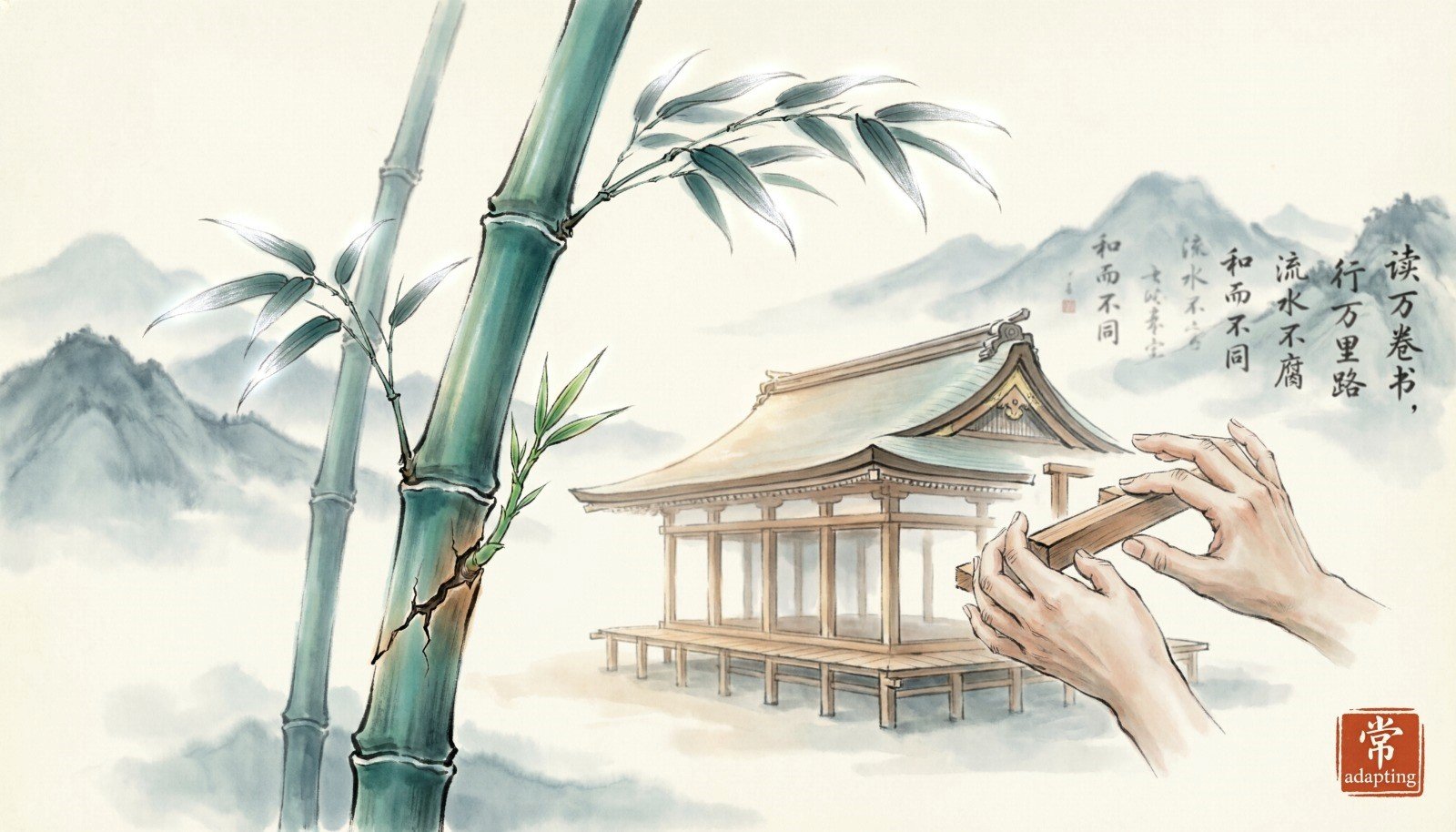
When Kakuzo Okakura wrote that "the art of life lies in a constant readjustment to our surroundings," he was not formulating an abstract theory, but rather distilling centuries of practical wisdom from the Japanese people. For the traditional Japanese, this readjustment is not a conscious effort, but a cultural instinct as natural as breathing.
Since time immemorial, the geography of the archipelago—earthquakes, typhoons, volcanoes—taught its inhabitants that rigid resistance is a sure defeat, while flexibility is survival. The traditional Japanese learned **to bend without breaking**, to rebuild what was destroyed not as an exact replica, but as an opportunity to improve. This is why the Ise Grand Shrines are dismantled and rebuilt every twenty years: it is not mere tradition, but an affirmation that true permanence does not lie in materials, but in the spirit that is transmitted and readapted.
This way of being manifests itself in every daily gesture:
- In the tea ceremony, the host adjusts every movement to the season, the light, and the guest's state of mind. No two encounters are the same; each is a unique readjustment to the present moment. Tea is not served the same way in summer as it is in winter, nor is it prepared the same way for an elder as it is for a young person.
- In the wabi-sabi aesthetic, the traditional Japanese finds beauty not in the perfect and unalterable, but in that which changes, rusts, cracks, or wears away. Imperfection is not a flaw to hide, but a mark of the passage of time that invites a new perspective.
- In the martial arts, the principle of ju (the softness that overcomes force) teaches that true strength lies in yielding to redirect, adapting to the opponent's movement rather than offering frontal resistance.
But perhaps where this constant readjustment is expressed with the greatest depth is in the relationship with the foreign. Throughout its history, Japan knew how to absorb external influences—China, Korea, and later the West—not as servile imitation, but as creative assimilation. The traditional Japanese does not reject the new, nor do they idolize it: **they transform it**. They dress it in their own sensibility, make it their own, and in doing so, reinvent it. Buddhism arrived from India via China and became something deeply Japanese; Chinese characters gave rise to Japan's unique syllabaries; Western technique fused with local craftsmanship to create unparalleled objects.
This capacity for constant readjustment does not mean a loss of identity, but quite the opposite. The traditional Japanese knows that **the essence is not defended by petrifying it, but by embodying it in every new circumstance**. Like bamboo, which sways with the wind but keeps its roots firm and its inner node unmistakable.
In daily life, this philosophy translates into a mindful attention to the present moment, in courtesy modulated according to the listener, and in the capacity to find the sublime in the humble. It is not a doctrine to be studied, but a rhythm breathed since childhood in the grandmother's gestures when preparing tea, in the way of bowing when greeting, and in the silence that accompanies the right word.
Okakura, formed in two worlds, knew how to name with Western clarity what his people lived since the dawn of time. By saying that the art of life is a constant readjustment, he did nothing less than translate into universal words the most intimate heartbeat of Japanese culture: one that understands that **to live is to flow**, and that true tradition is not to repeat the past, but to re-create it in every instant.
|
|
Art. 8
Art. 9
Book Corner: Technical Aikido
By Mitsunari Kanai Shihan, 8th Dan
Chief Instructor of New England Aikikai (1966-2004)
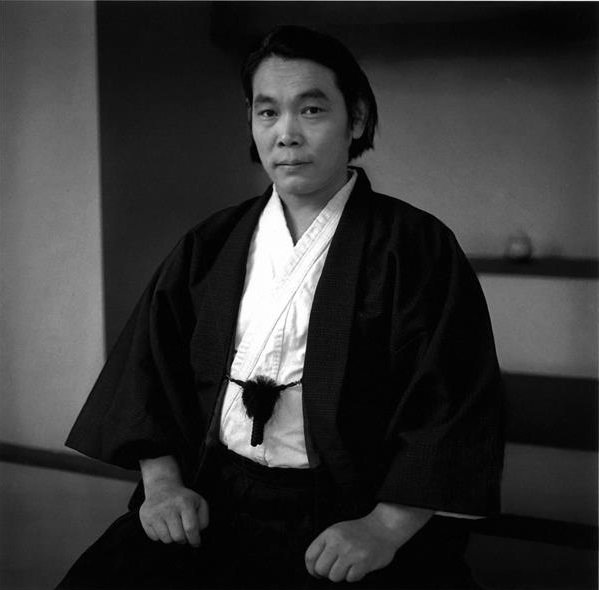
Editor’s note: Our “Book Corner” series features selected installments from works that inform and enrich our practice.
This issue presents Part 1 of Chapter 6, the concluding chapter of Mitsunari Kanai Shihan’s "Technical Aikido".
CHAPTER 6 - CONCLUSION: DEVELOP EYES TO DIFFERENTIATE TRUTH FROM FALSEHOOD - (Part 1)
Aikido is...
At the core of the practice of Aikido, more than anything else, is a continuous hard training and
disciplining of one's body and mind in order to develop wisdom. In the event of a confrontation,
beast-like behavior aimed solely at protecting oneself and injuring the opponent must be
avoided at all costs. To develop the determination to resolve a confrontational situation with
omniscience and omnipotence (that is, using not merely technique but applying the entirety of
one's abilities and wisdom) is BUGOKORO (Budo's spirit/mind). One must realize that Aikido is
neither more nor less than the expression and embodiment of this Bugokoro.
YAMATOGOKORO is what Aikido Advocates
Because Aikido includes the elements of BUGI (combat techniques), it is inevitable that, at
times, the Aikido practitioner must face the possibility and the reality of confrontational
circumstances. If one seriously and continuously probes into the reality of coming face-to-face
with an opponent in a show-down situation where one's very existence is at stake, that is, where
one's survival means the opponent's defeat or vice versa, and if one were to fully and openly
recognize the inter-relation between oneself and the opponent, it would lead one to discover the
most logical and efficient fighting techniques.
It is nonetheless true, however paradoxical it may seem, that in pursuing the perfection of this
principle, one will eventually arrive at a harmonious state, born from the insight that no matter
how strong one is, one cannot continue to exist if one tries to fight against all existence. This is
the "Way" (or process) to reach harmony as advocated by Aikido.
One should bear in mind, however, while trying to understand or attain the principle of harmony,
that without going through the internal transformational process that begins in the state of
confrontation and only after working through a critical process eventually arrives at the state of
non-confrontation, there can be no Budo.
Under normal conditions, living things live in groups, not alone. A basic feature of social
existence is the development of relative descriptions or comparisons, for example, strong
versus weak. Each being tries to use its individual qualities to best advantage in light of its
relative strengths and weaknesses. The process that eventually led to Budo began with efforts
to compensate for weakness by developing specific qualities (for example, speed, or strength, or
size, or facility in using weapons). Therefore, under normal conditions, living in the world leads
at times to confrontational situations, and developing increasingly effective techniques for facing
such confrontations eventually leads to the realization that there is always someone or something
bigger or stronger than oneself. Ultimately one realizes that the most effective
defense is to merge with and become part of the opponent. This is how the principle of
confrontation evolves into the principle of non-confrontation.
Yamatogokoro is the idea that the reason for developing martial arts is to protect those who are
unable to protect themselves from aggressors. The proponent of this philosophy devotes
himself to developing Budo in order to protect the security of peaceful people from the victory of
cruelty and violence. This idea is at the heart of Aikido.
It should be understood that Aikido includes a philosophy and ideas that go beyond martial arts
defined as the practice of combat techniques. Therefore, martial arts is included within Aikido,
but Aikido goes beyond martial arts. Aikido stands for the idea that Budo, the principle of
confrontation, and the principle of non-confrontation can be synthesized without compromising
any of their fundamental essences. However, it is sad to note that much of what is called
practice has compromised these elements. What follows is a technical description of the
physical principles which must guide true Aikido practice if it is to achieve total, rather than
partial, realizations of this art.
CHAPTER 6 - CONCLUSION: DEVELOP EYES TO DIFFERENTIATE TRUTH FROM FALSEHOOD - (Part 2)
Conclusion
I firmly believe it is worthwhile to admire, appreciate and praise the beauty of Aikido's movement
and the beautiful, harmonized stability produced by its advanced techniques and highly trained
skills. Because it looks beautiful to the eyes of spectators and has an artistic side through which
a person can display his own philosophy, Aikido has gained widespread recognition and has
spread broadly in society.
Because of Aikido's unique characteristic that its techniques avoid confrontation and
create unity and harmony, Aikido has been accepted by the world and praised by many people
as the beautiful Budo of Wa (the martial art of harmony). Also, there are people who, as if
responding to a social demand, go so far as to think of and seek Aikido based on a view that the
technical beauty of Aikido is the essence of Aikido.
Although the movement of Aikido looks very beautiful to the eyes, one must not lose sight of its
true essence. We tend to be caught up with its beauty. But because we are too attached to this
beauty, we tend to lose the essence of Aikido and the direction its practice should take. I wish
people to know that Aikido's beauty as a form, which surfaces externally, is only a by-product of
its practical effectiveness in coping with the fighting relationships of attack and defense that
arise inevitably in our current social system.
The reason why I seek practicality rather than beauty in Aikido is that I want to observe the
essence of its fundamental substance correctly even when manifested in how beautiful it is. I
have spent my entire life and an enormous amount of energy so that I will not fail to recognize
the Way of Aikido. I have been doing it only for this.
If one can look hard and purely at the essence of Budo, one would recognize without fail that
Aikido is not a fancy kind of sport. I wish that people would not forget that to look hard at Aikido
through the eyes of Budo, which is based on the principle that the rational and practical
substance of a thing is its most beautiful aspect, is of critical importance in learning Aikido, and
comprises the greatest part of its practices.
Technical Aikido © Mitsunari Kanai 1994-96
|
|
Comic10
Comics - Aikido Animals: The Awkward
By Jutta Bossert
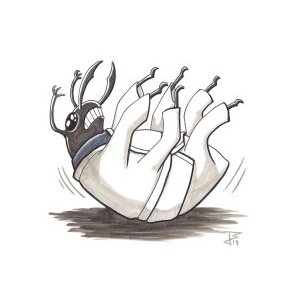
The Awkward
It hurts to watch their stiff, angular rolling.
But you have to admire their determination
as they try again and again and again.
© Jutta Bossert - Used by permission.
|
|
Art. 11
Challenge Yourself
By Michael Aloia
Dojo-cho Asahikan Dojo, Collegeville, PA
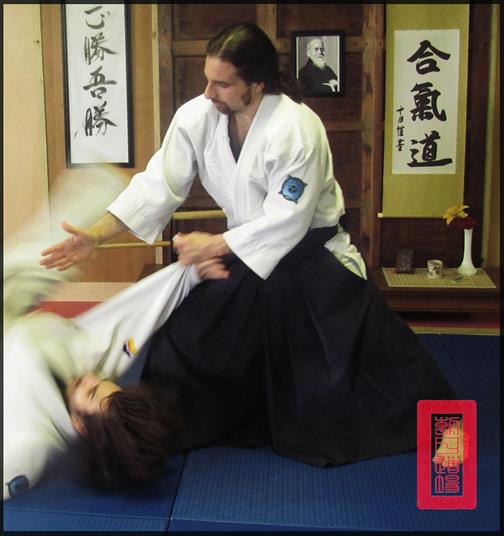
Challenge where you are…
Challenge what you know…
Challenge what you don't know…
Challenge who you are…
Complacency is often more of a detriment to our efforts of furthering success than the obstacles that often await us in our path. Most obstacles are overcome in time through awareness, diligence, determination and skill. Yet we all run the risk of becoming comfortable at one point or another. Being comfortable, however, is not a bad thing per se. There are some benefits to comfort as we all want to function in our roles effectively and efficiently, and a level of comfort is required to achieve such a state. Confidence is established in certain comfort zones.
However, becoming too comfortable could result in a lack of focus and progress, lower standards, and resistance to change, thus lowering expectations of ourselves and others, and simply taking things for granted. Here’s where problems could arise. We often begin to overlook the obvious. Our attention to detail becomes compromised. Routine becomes the norm. Efforts begin to diminish as we make excuses to cover up our lack of growth. We lose our edge. And it’s that edge that keeps us challenged, keeps us aspiring, and keeps us growing as individuals while in turn growing as a community.
If comfort, at its most basic level, provides us with a foundation of confidence, then to prevent complacency, to avoid missing the obvious, to prevent lowering of standards, we must use that confidence and challenge everything we think we know including the person who we consider ourselves to be, every single day. It's a matter of working toward the “who” we want to become, not the “who” we currently are.
Challenging ourselves is a victory within itself. Making that first step can make all the difference. Such endeavors undoubtedly require hard work on our part and come with a series of uncomfortable moments that will not be easy, but well worth it in the end.
Challenge yourself to greatness...
|
|
Art. 12
Aikido for Mental and Physical Health
By Mykola Yemelianov
Dojo-cho, Kyiv Aikido Club, Kyiv, Ukraine
Since receiving its Provisional Membership in the Shin Kaze Aikido Alliance, the Kyiv Aikido Club
has continued to develop its skills along the path of Aikido.
Our students not only practice regularly in the dojo but also attend seminars with masters who now,
although infrequently, come to Ukraine. At the end of October 2025, our adult aikidokas attended a
seminar in Kyiv with Andreas Falk, 6th Dan (Sweden). This was Andreas's first visit to Kyiv
and his introduction to Ukrainian clubs. The seminar was held in a very friendly and productive atmosphere.
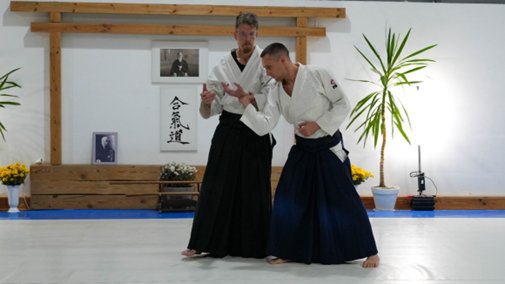
Our students also attended the now-traditional seminar with Stephane Benedetti (7th Dan) and
Miguel Salvador (6th Dan), which took place in November 2025 in Uzhhorod. Traveling to seminars is always
a great opportunity not only to train with practitioners from other cities, but also to enjoy walks and
sightseeing in the company of like-minded people.
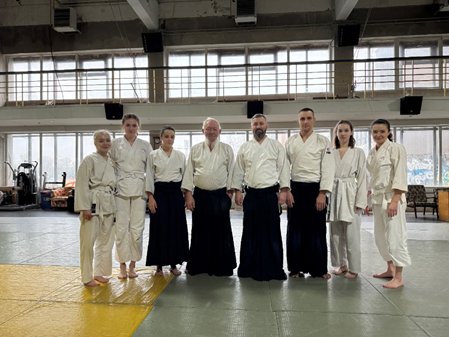
At the end of November 2025, the Aikido Aikikai Academy in Uzhgorod organized a seminar for children and
teenagers, led by Sensei Mikhailo Korozey, 4th Dan, and our club's head, Mykola Yemelianov, 3rd Dan. It
was an excellent exchange of experience with the Uzhgorod Senseis and their students.
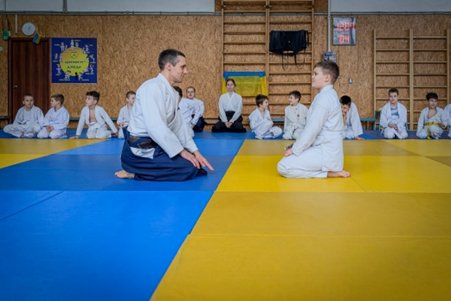
At the end of December 2025, our traditional student belt examinations took place. Approximately 60 children,
ranging from 10th to 5th Kyu, and 20 adults, ranging from 6th to 3rd Kyu, successfully passed their exams.
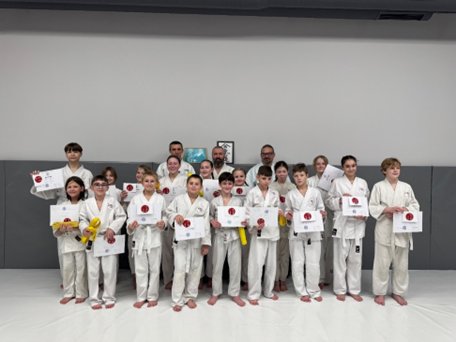
At the end of 2025, in anticipation of the holidays, we organized a team-building event for adult students,
as well as festive training sessions for both children and adults. These sessions enjoyed a warm, pre-New Year's
atmosphere and concluded with a small dessert buffet. We believe that regular training sessions are vital to the life
of the club, just as social events are essential for bringing all our members together, fostering a friendly
atmosphere, and lifting spirits during these challenging times for Ukraine.
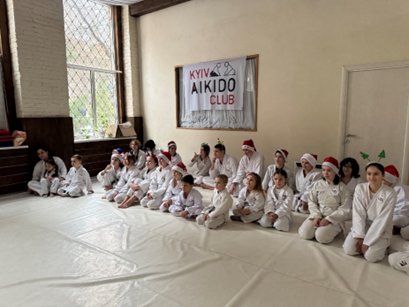
This past winter was quite difficult for everyone in Ukraine—marked by severe frosts along with constant power and heating
outages, all of which naturally impacted training and our ability to hold events. Nevertheless, our club never
stopped regular classes for both children and adults.
On April 15, 2026, the Kyiv Aikido Club celebrated its 7th anniversary since its founding and official registration with
the Ministry of Justice of Ukraine. To mark the occasion, celebratory training sessions were organized for
children and adults across all club groups.
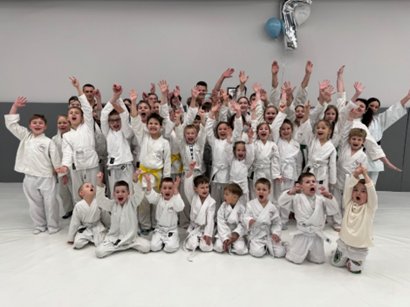
At the end of April 2026, we received the exciting news from the Shin Kaze Aikido Alliance that we became Full Members
as of May 1st, 2026. This is a great honor for us and another major milestone in our development.
Aikido helps people in Ukraine get through difficult times, supporting both their physical and psychological health.
We, as a club, are pleased to be able to offer help and support through this art. In addition to continuing our daily training, our
plans for the near future include participating in a seminar in Uzhhorod, a belt exam at the end of May, an
Aikido camp for children in July, and an远 Aikido weekend for adults in August.
|
|
Art. 13
Dojos granted Provisional Member status

We are pleased to announce that the following dojos have been granted Provisional Member status:
- Monserrate Aikido Bogotá, located in the city of Bogotá, Colombia, led by dojo-cho Alejandro Rojas Mora, godan.
- Isshinkai Aikido Dojo - Isla Margarita, located in the city of La Asunción, Nueva Esparta, on Margarita Island, Venezuela. The dojo is led by dojo-cho Luis Felipe Villarroel De la Concha (sankyu), under the supervision of Shidoin Rafael Pacheco (godan), dojo-cho of Venezuela Aikido Kokyu Ho Dojo in Maracay, Venezuela.
A warm welcome!
|
|
Art. 14
Hope must build a better world
By Luis Felipe Villaroel
Dojo-cho, Isshin Kai Aikido Dojo, Isla de Margarita, Venezuela
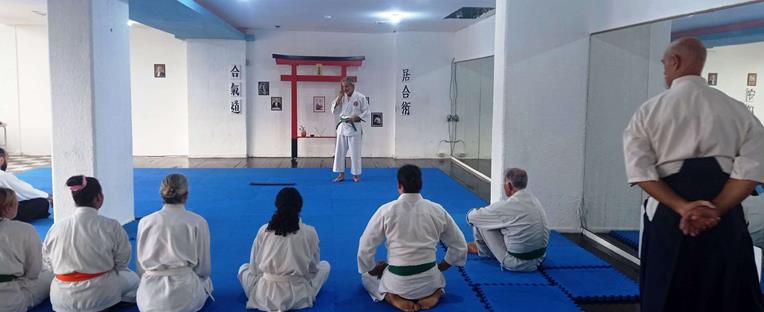
Hello, my name is Luis Felipe Villarroel, I am from Venezuela, and I live on beautiful Margarita Island. I am deeply grateful for the opportunity to be part of the great family that is the Shin Kaze Aikido Alliance. Being able to share this space with you is, without a doubt, one of the special moments I treasure on my path.
My story in Aikido began as a dream. For a long time, I felt the need to do something for the society around me, to plant a seed that could become a tool to build a better world, starting with my country.
Like many, my first contact was through movies and documentaries until life gave me the time and the opportunity to step into a Dojo. That was how I joined the Dojo of Sensei Manuel Cormenzana, where I practiced not only Aikido but also Iaijutsu.
That experience was the start of a transformative journey. With daily practice and the passage of time, I had the fortune of meeting other training partners and teachers, and little by little, I began finding the answers I had been searching for so much. I became like a sponge, eager to absorb this fascinating knowledge that opened a new portal in my world.
From my sixth kyu until today, my practice has not been limited to the tatami; I have worked with children both inside and outside the Dojo, developing pedagogical activities that complement my martial work.
However, destiny dictated that my Sensei could no longer continue in Venezuela. Far from giving up or staying stagnant in the middle of building my dream, I decided to forge ahead. Today, with gratitude and determination, I am the dojo-cho of Isshin Kai Aikido Dojo, and alongside my training partners, I continue to walk this path of the Martial Arts and Aikido.
Thank you very much for reading my words and for giving me the opportunity to let you know a little bit about who I am.
With respect and affection,
Luis Felipe Villarroel De la Concha.
|
|
Art. 15
Yudansha Promotions
The following Shin Kaze member promotions were submitted for registration at Hombu Dojo in June:
Yondan (4th dan)
Caroline Zeiss - New Haven Aikikai - USA
Sandan (3rd dan)
Brenda E. Caldwell - New Haven Aikikai - USA
Nidan (2nd dan)
Franklin De La Hoz - Marubashi Aikido Dojo - Venezuela
Shodan (1st dan)
Juan Pablo Bobadilla - Kokoro Dojo - Argentina
Ludmila Abigail Ocampo - Kokoro Dojo - Argentina
Adriana Carolina Rada - Kokoro Dojo - Argentina
Nicolás Rivadulla - Kokoro Dojo - Argentina
María Paz Santillán - Kokoro Dojo - Argentina
Volodymyr Parkhoniuk - Sei Fu Kai Dojo - Ukraine
Iaroslav Soroka - Sei Fu Kai Dojo - Ukraine
Our heartfelt congratulations to everyone—please keep up the great work!
|
|
Art. 16
Art. 17
Art. 18
Art. 19
Art. 20
Dear Dojo-cho and Supporters:
Please distribute this newsletter to your dojo members, friends and anyone interested in
Shin Kaze Aikido Alliance.
If you would like to receive this newsletter directly, click
here.
|
|
|

|
SUGGESTION BOX
Do you have a great idea or suggestion?
We want to hear all about it!
Click
here
to send it to us.
|
Donations
In these difficult times and as a nonprofit organization, Shin Kaze welcomes donations to support
its programs and further its mission.
Please donate here:
https://shinkazeaikidoalliance.com/support/
We would also like to mention that we accept gifts of stock as well as bequests to help us build
our Shin Kaze Aikido Alliance endowment.
Thank you for your support!
|
|
|
|
|
|