Comments
Header
News from Shin Kaze
April 2026
Shin Kaze Aikido Alliance is an organization dedicated to the practice and development of
Aikido. It aims to provide technical and administrative guidance to Aikido practitioners and
to maintain standards of practice and instruction within an egalitarian and tolerant structure.
|
|
Contents
Intro
Introduction
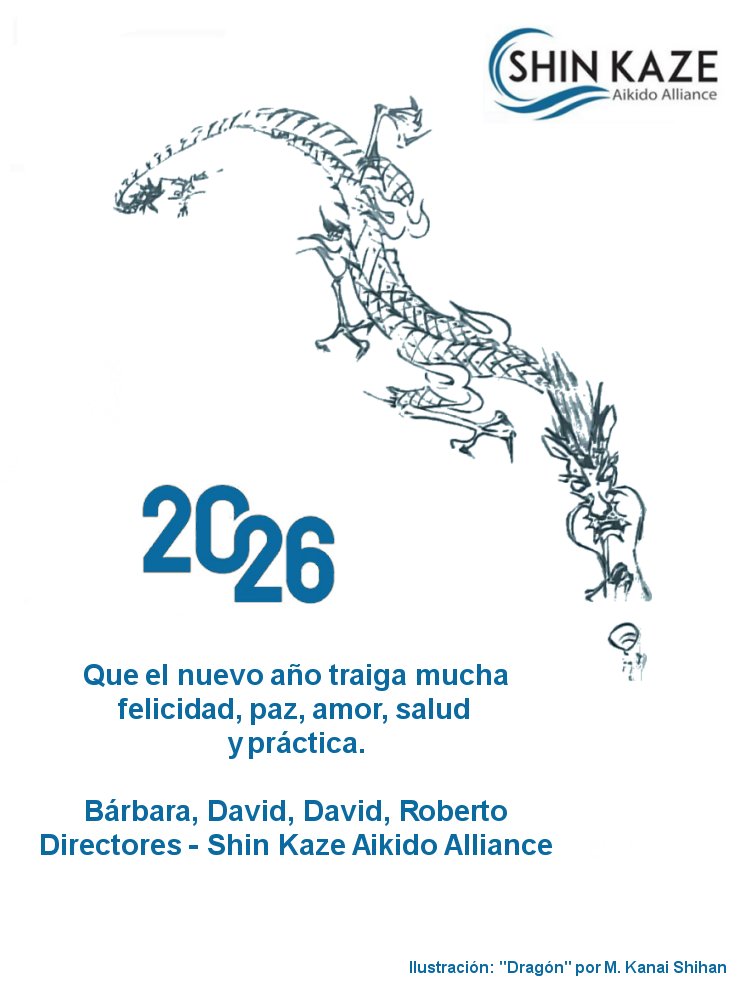
Welcome to the April 2026 edition of the Shin Kaze Aikido Alliance Newsletter!
As spring brings renewal and fresh energy in the northern hemisphere, and autumn ushers in reflection and
transformation in the southern hemisphere, we celebrate the dedication and spirit of our Aikido community.
In this edition, we honor remarkable teachers, share inspiring student experiences, and highlight events
that strengthen the bonds between practitioners around the world.
We extend a warm welcome to new readers and contributors. This newsletter connects Aikido practitioners
from across the globe, offering a space to share experiences, ideas, and perspectives in their own words.
Even when we cannot meet on the tatami, this newsletter helps us stay in touch, exchange insights, and
inspire one another. Perhaps it will even encourage some of us to explore new experiences and deepen our
practice, all within the spirit of Aikido.
In this issue, you’ll find reflections on training journeys, stories of growth and resilience, updates on
seminars and workshops, and celebrations of mentorship and community. Contributors include those returning
to practice after family commitments, beginners who have devoted their time and heart to Aikido, and students
from diverse countries and Aikido organizations. We are grateful for your insights and for sharing them with
our community.
Whether you are new to Aikido or a seasoned practitioner, we hope this newsletter sparks curiosity, deepens
your practice, and strengthens connections with fellow practitioners. Please consider sharing your own
experiences—your words help keep our global Aikido family connected.
|
|
Art. 2
Spiritual Tangibility
By Michael Aloia
Dojo-cho Asahikan Dojo, Collegeville, PA
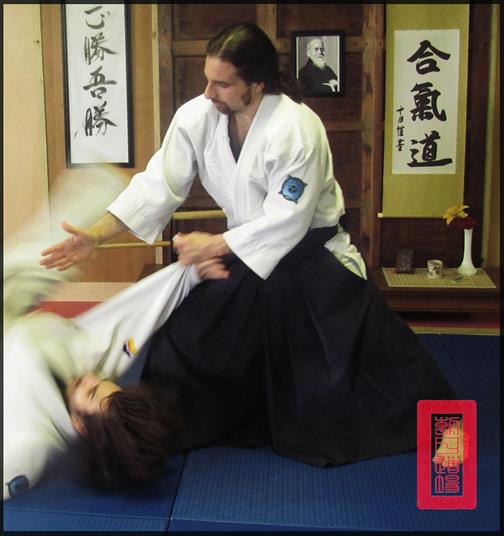
Tangibility in the martial arts keeps many of us coming back. Not so much in the way of what we can hold but by what we can do - a performance tangibility. How high we can jump, how fast we can move or how hard we can hit. The more we can do, the better we are. Purely physical training will produce purely physical results. These results will be short lived given the nature of the human condition - for many, as we age, strength, flexibly, stamina, etc. will diminish. At some point, we will all experience a physical deficiency.
The physical aspects are just the beginning. Like a gateway, they can be a tool that builds spiritual prowess. However, it is the spirit that drives the mental and fuels the physical. This connection from the spiritual to the physical and back again is where our true power and self can be reached, realized, and made reality. There is nothing but success. As we draw closer to strengthening our spiritual abilities we can begin to tailor our physical and mental needs accordingly. We begin to polish the sword when appropriate as well as sharpen the blade when necessary - each having the proper place in our training - one enhancing the other.
How do we accomplish such a feat as the spiritual? Many of us already have within our training, regardless of style or art, specific areas where spiritual enhancement can be achieved - such as the minutes before class begins. Instead of socializing with others, we can use that time to empty our minds of the burdens of the day, leaving any baggage we carry at the door. In the moments as we line up to bow into class and to the instructor, we can reflect on the positive energy of the art and the information and opportunities before us. During class, as we observe and listen to the instructor's teachings and work with our partners, we can be mindful of our intent for training and remain aware of our breathing, maintaining a relaxed but attentive demeanor and posture. As we line up to bow out of class and to the instructor, we can consider the progress we have made and the lessons we carry away with us. Furthermore, with the inclusion of intensive training, meditation or spiritual sweeping, as a purposeful ingredient to our training, we may find we are able to rid our thoughts and feelings of many attributes that would plague our progress, clearing our thoughts of unwanted energies that only hinder and create obstacles along our path - focusing only on the moment. These are but a few of the opportunities that can present themselves throughout our regular training regimes.
Spiritual growth may not be as tangible in the beginning as the physical results are but over time, how we choose to see the world and more importantly, ourselves, will change. And this change will affect everyone and everything around us. Physical feats are great but they are short lived, and at times, require us to work towards others' expectations, assumptions and desires - misplacing or, worse yet, abandoning our own. Spiritual growth, however, is forever, even if at times things feel jumbled, and the rewards are endless. Take a moment and consider the possibilities as you venture into a new level of your training.
|
|
Art. 3
The world, an uke
By
Maria Paz Santillan
Kokoro Dojo, Córdoba, Argentina

How many times have we stopped to think about all the difficulties the world offers us? Our world: that chaotic, almost disastrous one that can barely stay in balance; a world full of wounds, bruises, fractures, and torn ligaments; at times scattered, lost in itself, distracted, sometimes angry, other times content… and tired… very tired.
Have you ever stopped along the way to sit down and complain about it? To criticize it and say, “It’s impossible to achieve anything with this world”… Of course you have. Who hasn’t? Whoever says no is probably lying… Who wouldn’t want a world that’s easier to handle? One where there are no difficulties, where it’s simpler to do what one wants, to be comfortable, to fulfill dreams; a world where one doesn’t suffer or face conflicts, where there are no fractures or tired knees, and one can walk calmly along the path of life without fear of anything truly bad happening…
Something similar happens to us on the tatami, doesn’t it? At some point our Sensei has told us: “If the technique doesn’t work, never blame your uke. Each person must find a way to perform the technique however they can.” And in my mind, as the months went by, a new idea emerged: what if in life our family members, our coworkers, our friends, are our ukes? What if the world is an uke, and I must find a way to realize myself however possible, despite everything it is? And what if I myself am not the perfect uke either?
But the “ideal” uke doesn’t exist and never will, and if they did, we wouldn’t learn anything about Aikido there… Perfect friends, the perfect family, the perfect partner—none of that is possible. It would be like asking the other person to hand everything to us ready-made, and expecting that only from there we could build ourselves, live as we wish to live, fulfill our desires, go where we want to go.
Sometimes the uke is taller, sometimes shorter. Sometimes heavier, sometimes thinner. With more experience or less experience. Strong and firm, or soft and without strength. Shy or extroverted. Talkative or quiet. Sometimes an uke accompanies you, and other times they struggle or don’t know how. Sometimes an uke falls, other times they don’t know how. Sometimes an uke flies, and others need a hand to go down. Does Aikido change when the uke changes? Should the technique we perform adapt to the conditions of each uke, or should the uke adapt to the technique and to us? Or is that precisely the point of the harmony we seek so much, and that takes so many years to learn?
The uke cannot hold you up, and you cannot hold up your uke. That wouldn’t be Aikido. The world, life, is not and will never be the perfect uke, but look how interesting: it is the practitioner who is always there, the one with perfect attendance on the tatami, who every day gives us the opportunity to practice with it—with its shortcomings, of course (like all of us)—but also with its great virtues and possibilities, and a wisdom of thousands and thousands of years… a wisdom that depends solely and exclusively on us to know how to hear and receive.
Perhaps seeing its strengths and possibilities more than its flaws or lacks is also a way to begin practicing more calmly, with less resentment and more compassion, love, and harmony. (Aikido did mean “the way of Harmony,” didn’t it?)
Something to think about, yes: there is something that should not change depending on the uke—posture always firm with a straight back, conscious breathing, and fluidity of movement. The most difficult ukes, I believe, are the ones who teach us the most about training these things, and I never want to forget that one is always the uke of one’s uke. Many times that is also a great lesson.
|
|
Art. 4
2026 Yudansha Promotions
Promotions for the following Shin Kaze members were sent for registration at Hombu Dojo in February:
Yondan (4th dan)
Francisco Matamala - Andes Aikido Dojo - Chile
Luis Javier Otiniano - Niji Dojo - Perú
Sandan (3rd dan)
Nidan (2nd dan)
Rúbel Batista - Samurai Dojo - Uruguay
Rajesh Jaiswal - Framingham Aikikai - USA
Carlos Alberto Jara - Aikido Santa Fe Miyazawa Dojo - Argentina
Alejandro Lena - Samurai Dojo - Uruguay
Brad Myers - Framingham Aikikai - USA
Shodan (1st dan)
Javier Lopez Gafarot - Niji Dojo - Spain
Nicolás César Orazi - Aikido Santa Fe Miyazawa Dojo - Argentina
Rúben Rijo - Samurai Dojo - Uruguay
Our heartfelt congratulations everyone, please keep up the good work!
|
|
Art. 5
Claude Berthiaume Shihan
November 1954 – March 2026
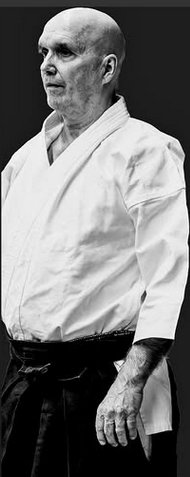
Shin Kaze Aikido Alliance is saddened by
the loss of Claude Berthiaume Shihan, 8th dan,
Chief Instructor of Aikido de la Montagne in Montreal,
and member of the Board of Directors and the Technical Committee
of the United States Aikido Federation.
His passing leaves a significant void in the Aikido community.
Shin Kaze extends condolences to his family, students, and friends.
We will all miss him.
|
|
Art. 6
Mayor shares his own story during international martial arts seminar in Wells
By: Roxana Gramada,
Aikido Aikikai, Romania
As published in The Somerset Leveller Newspaper, Somerset, England
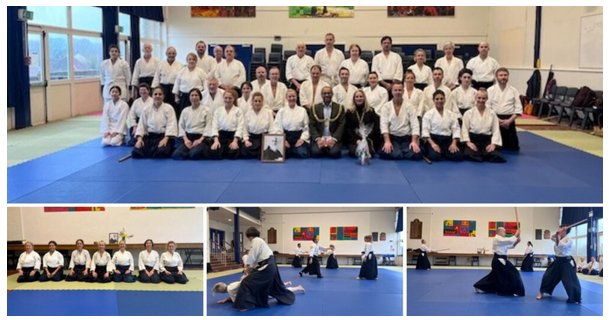
A Somerset music hall was filled with the sounds of martial arts during a special event last weekend - with one dignitary revealing how
his own hobby had helped him overcome bullying.
The Blue School, in Wells, hosted Aikido students and teachers from 12 countries spread across four continents for a seminar with a spotlight on women teachers.
Among those looking on was Mayor of Wells, Councillor Louis Agabani, along with Mayoress Mary-Ellen Nowell.
The pair were treated to a demonstration of the contemporary Japanese martial art, led by seven visiting teachers, and Mayor Agabani shared how he struggled at school until he started Judo and later, Shotokan karate.
Studying the martial arts helped him as a young adolescent understand how important discipline and respect is in our lives, he said.
"Thank you everyone for coming from so far away. We are all so glad Wells has become an important centre of the world for martial arts as well," the mayor said.
The event was created by Fiona Blyth sensei, sixth dan Aikido Aikikai of the Shin Kaze Aikido Alliance, who was born and raised in Somerset before moving as a teenager to the United States.
"Ai means harmony, ki means energy and do is the way. I hope that ai-ki-do will show us the way together with respect and dignity, so we can treat each and
every one with humanity and kindness," said Blyth sensei.
Countries with representatives attending the seminar in Wells were Bolivia, Canada, France, Hungary, Italy, Japan, The Netherlands, Romania, Switzerland,
the UK, the US, and Venezuela.
|
|
Art. 6a
What is Aikido?
By Fiona Blyth Shidoin
Dojo-cho The Wind on the Top of the Mountain, UK
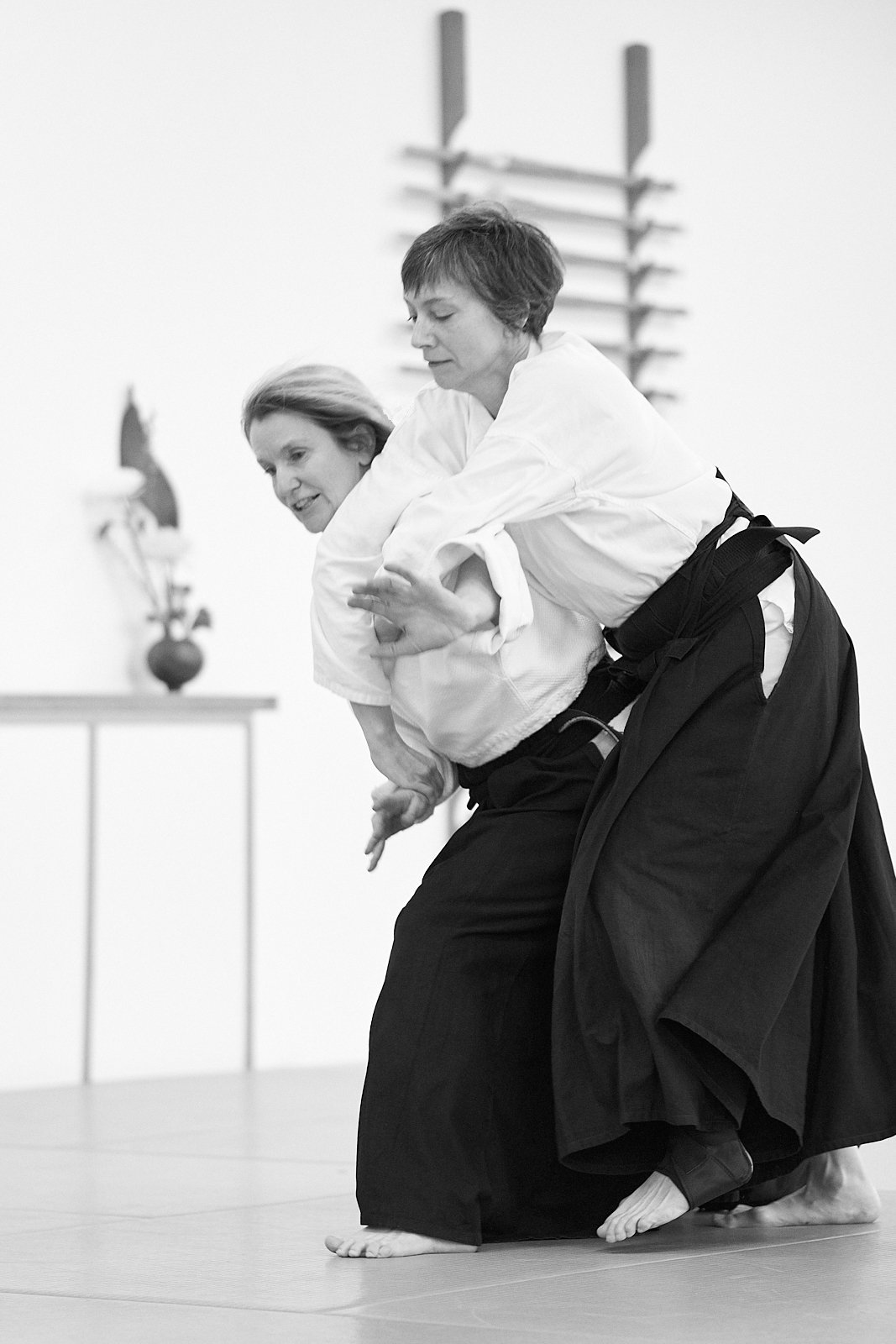
From March 6 to 8, 2026, I organized an international Aikido seminar led by women instructors.
It was the second year I had initiated this event. I must admit, I was reluctant to do it
again—the stress, the worry, the endless work… it all felt overwhelming. But then I thought
of Kanai Sensei, my teacher. He taught so many seminars, he taught every day in the dojo
(often at noon and in the evening), he taught weekends, traveled to other dojos to teach,
and gave of himself at every opportunity. He organized our annual summer camp, always pulling
us together pushing us forward, and striving to lift us up. If he could give so much, surely
I could try a little harder too.
During this year’s seminar, I was asked countless questions—so many, and so varied.
Why this seminar? Why in the UK? Why in Somerset? Yet, amid all these,
one question kept rising again and again, echoing through the weekend: What is Aikido?
Before providing my response, I would like to turn the question to you: What is Aikido?
What does Aikido mean to you? I would be delighted to receive your answers, and, if possible,
to feature them in our newsletter. Feel free to include a photo as well, if you wish!
So what is Aikido to me?
When I was asked this question by the Mayor of the City of Wells, Somerset, UK, who had kindly
accepted my invitation to come and welcome the international instructors, I did not have
a pre-prepared answer nor a speech, as I do not like speaking or being in front of others!
Although Aikido has been a part of my life for 43 years, at that moment my mind was blank.
Jeni Edge (a practitioner of Aikido for just over a year who maybe knows more than she lets on)
immediately suggested - just talk from your heart. So this is part of what I said: I explained the basic
concept of the meaning of the kanji of Ai-Ki-Do and that I hoped that Aikido will show us the way, together,
with respect and dignity, so we can treat each and everyone with humanity and kindness.
The rest... well, Aikido is above all a Martial Art, but why is it so important in my opinion in this day
and age to learn Aikido, not just any martial art?
Maybe because the constant practice of Aikido harmonizes body and mind, and the main role of Aikido is to
harmonize, with ourselves, with Nature, with others, and to protect, not to harm, not to kill
and not to destroy, through Budo.
I believe we have a duty as humankind to protect the world, to protect the environment and to protect all living beings
of which we are one.
Through Aikido we learn respect, dignity, self-discipline, and control, and we try to seek to understand
the world around us, not judge, and to understand one another, and harmonize.
Why did I choose to bring seven different instructors, who happen to be female, who come from different Aikido
schools, different countries, different continents? Because that is what Aikido is to me - that the more we can
come together, to pull together, to harmonize together, through hard, sincere physical practice, maybe somehow we
can spread understanding and Peace throughout the world.
That is my wish, and my belief, we need Peace within us more than ever, in our world and to unite together,
rather than to separate and become individualists.
Our society is tending more and more to form into small pockets, distancing from the physical. Aikido forces
us to physically confront each other and to confront ourselves and our weaknesses and then to find a solution,
to harmonize.
Why do I use the word Harmony? Think of music - harmony - energy which can lead to Beauty, which can lead to Truth
and maybe to more understanding together.
I hope.
|
|
Art. 6b
Arriving at Aikido
By Jennifer Edge
Aikido Alive, Wells, UK
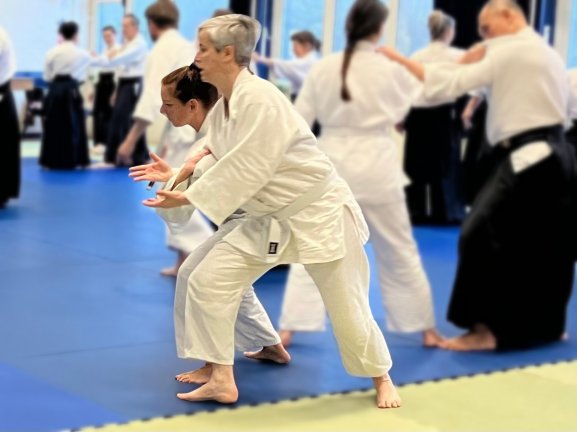
It would be a long and complicated tale to explain all the intricacies of how I came to be
in my late-forties and starting to learn a martial art. It is sufficient to say that I
injured myself and was no longer able to do certain activities and, instead, my attention
was drawn to pursue a fledgling desire I had been incubating for a while; to understand
more about the art of Aikido. This desire came from a love of things Japanese born out of
a few years of Zen practice, and an interest in embodied practices and energy work stemming
from my work and studies as a body worker and talking therapist, and keen horsewoman.
That’s one version of the story. It’s difficult really to put into words what drew me to
Aikido, and to the dojo where I practice. Curiosity, proximity, fate, good luck, discernment,
desperation, all and none of these could be true. What matters is that I found it and am
profoundly grateful for what has unfolded from that first encounter.
Aikido was not what I expected. It’s been more dynamic, more challenging and more rewarding
than I could have imagined. I feel so grateful to have met my teacher, Bjorn Sensei, and his
students who all generously share their expertise and understanding. The joy of meeting and
training with so many experienced practitioners has been transformative and inspires me both
on and off the mat.
It has been an honour to have been able to support Fiona Sensei in her vision of hosting an
International Seminar for Women’s Day with all women teachers. My practice was only a few
months old when the first Seminar was held right on my doorstep. The good fortune of having
so many senior women teachers in one seminar wasn’t lost on me, but I wasn’t prepared for
the depth of what these intense days of Aikido practice would move inside me and the
friendships I would make.
In these times of instability, uncertainty, war and division my experience of starting
Aikido at my age has been a sincerely hopeful act personally and politically;
a commitment to community and friendship that crosses borders and cultivates a shared
understanding of how greater peace and harmony can exist in our times.
|
|
Art. 7
Aikido across borders: my experience in Wells
By
Sofia Encarnação
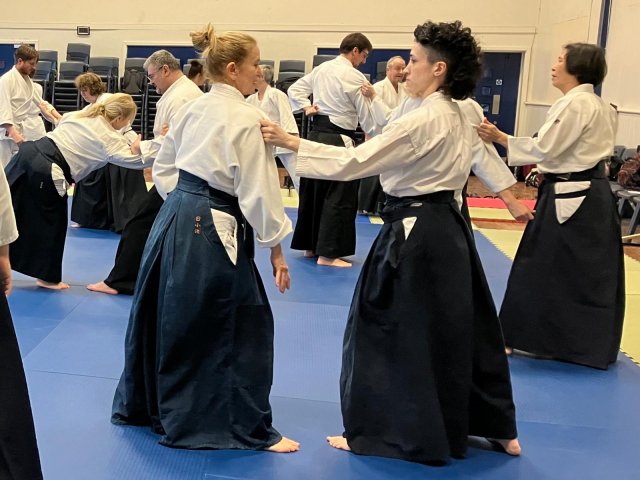
This past month I was fortunate to have the opportunity to visit the City of Wells, in Somerset, England for a seminar.
This seminar was organized by one of my Sensei, Fiona Blyth, to celebrate International Women's Day and amazing female
teachers in the Aikido community. The teachers were from different countries with their own techniques and styles.
It was nice to see some familiar faces as well as meet so many new people from all over. Aside from assisting with kids’
classes at my home dojo, this was the first time that I wore a hakama. It was an interesting experience. I felt both more
and less confident in different ways. It was a little intimidating but also exciting. It served as a preview for what may
be in my Aikido future.
The teachers and many of the seminar attendees stayed in a hostel and cooked together. Everyone was so welcoming and kind
on and off the mat. It always amazes me the kind of people that Aikido brings together and I feel so fortunate to be a part
of this community. If I didn't have Aikido in my life, I would never be able to have these kinds of experiences. I am so
grateful for my teachers who push me to keep training.
|
|
Art. 8
Beyond my comfort zone: the youngest on the mat
By: Khanh-My Ung
13 year old student at Blackheath High School for Girls, London
Byakudo Aikido, London, UK
Foreword
by Fiona Blyth Shidoin
Dojo-cho, The Wind at the Top of the Mountain, UK
Recently, I received an email asking whether I would allow a 13-year-old student to attend the International Aikido Seminar I was organizing in the city of Wells. Without hesitation, I said yes—and was surprised to learn that frequently younger students are not permitted to attend weekend courses or seminars where the majority of participants are adults.
To me, this seems unusual. If we believe that Aikido spreads the message of peace, and if Aikido teaches respect and discipline, surely we should want the next generation to learn Aikido and, as one fellow instructor put it, become “responsible global citizens.”
I was delighted when Mimi—as she is sometimes called—attended the seminar. Not only did she participate the entire weekend, she actively engaged in every class and even assisted with demonstrations.
We need to encourage more young people to take up Aikido. I am inspired by programs for youth and children. The younger generation is not only the future of Aikido—they are the next leaders and the future of our world.
As adult practitioners, I believe we have a responsibility to ensure the continuity of Aikido. The best way to do this is to encourage young people to get on the mat and to organize courses and camps specifically for children and youth.
Below is the article which Khanh-My wrote about her experience at the international Aikido weekend. I hope her story inspires other young people to try Aikido—and encourages adults to welcome young students onto the tatami alongside them.
_____
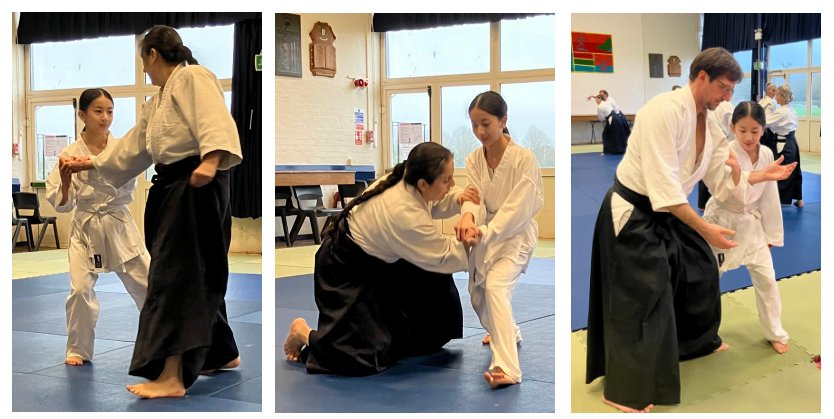
At the seminar, I was the youngest participant, and everyone else was older and much more experienced than me. At first, I felt a bit apprehensive because of the age and skill gap, but I quickly realized what an amazing opportunity it was to be so out of my comfort zone.
I was so grateful for Sensei Fiona’s kindness and teachings. Watching the seven female Sensei from around the world was inspirational, as they each had their own Aikido style, and they also challenged the usual stereotype of martial arts being dominated by men.
Training with people of all sizes and levels helped me notice where I could improve. In the seminar, most people wore hakama; it was a sight to see so many hakama on the tatami. Overall, this left me feeling motivated to keep learning and develop my skill set. The learning has enlightened me for my journey and has given more depth to my understanding of Aikido. I’m looking forward to next year’s seminar already.
Khanh-My
|
|
Art. 9
Book Corner: Technical Aikido
By Mitsunari Kanai Shihan, 8th Dan
Chief Instructor of New England Aikikai (1966-2004)
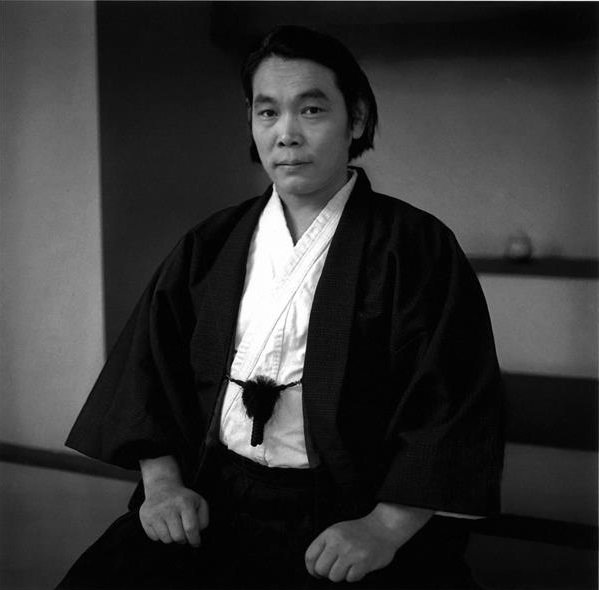
Editor’s note: Our “Book Corner” series features selected installments from works that inform and enrich our practice.
This issue presents Chapter 5 of Mitsunari Kanai Shihan’s "Technical Aikido".
Because earlier issues published this chapter in five separate parts—an approach that fragmented related ideas—we now
offer the full chapter here in one complete, continuous presentation.
CHAPTER 5 - UKEMI - (Part 1)
In this chapter, I will not address the complexity of defense in general; rather I will limit my discussion mainly to the relationship of Uke to Nage (the "other" or "partner") by focusing on how to fall and/or how to be thrown. Even in this limited examination, we must recognize several key issues.
First, one must understand the proper mental attitude appropriate to those who maintain and pursue the true form of "Bu" (martial arts). In developing the correct approach to ukemi, one must learn to master the ukemi techniques appropriate to any kind of waza (techniques) received from the Nage. This implies both receiving the full force of the Nage's technique, and also making the Nage's technique more refined or "polished".
Therefore one must understand these requirements while maintaining a serious attitude, as manifested in displaying correct manners to the Nage.
The following are simple descriptions of ukemi techniques; however, one must not forget that the basics of learning ukemi require one to practice executing all types of ukemi with a flexible body, a sharp mind, and an accurate judgment of the situation. Also it is essential to abandon an overly dependent relationship to the Nage; that is, a relationship based on a compromise of the principle that Uke and Nage are connected by a martial relationship.
There are several implications of this relationship. For example, Uke must not fall unless Nage's technique works. Also, Uke's technique must not depend on the assumption that the Nage will be kind, or that he will fail to exercise all his options, including kicking or striking the Uke if openings exist.
In training, one must polish one's own technique as well as the technique of one's partner, but at the same time one must maintain an attitude as serious and strict as if facing an enemy. This is the basis for a relationship that moves to higher levels based on a mutual commitment to polishing each partner's Aikido.
CHAPTER 5 - UKEMI - (Part 2)
Koho Kaiten Ukemi (Back Roll ukemi)
The basic requirements of Koho Kaiten ukemi are to be able to take a back roll without hurting yourself when being thrown, and further, to always recognize that the most dangerous element in a martial situation is the person whom you are confronting.
You must practice with the understanding that the bottom line of Bujutsu (martial arts) is to protect yourself from the opponent(s) in any circumstances and at any point in time. This imposes certain technical requirements on the techniques of ukemi.
Failing to understand these requirements can create disastrous consequences for the current practice of Aikido. One can observe this in a commonly seen way to do Koho Kaiten ukemi.
In this case, the Uke begins his Koho Kaiten by stepping back with the inside leg (i.e. the leg closest to the Nage), bending the knee until the knee is touching the floor (in a kneeling posture). The Uke then puts the buttocks down on the mat and first, rolls backward and then rolls forward while touching the same knee on the mat and, finally, stands up.
Doing the backward roll in this way shows an insufficient awareness of the acute dangers inherent in performing all these movements directly in front of the opponent. What are these dangers?
First, you must realize that stepping back with the inside leg means you are exposed to a kick. Furthermore, to lower the inside knee to the ground after stepping back in this way shows a potentially fatal carelessness due to the exposure to a kick, and also to the loss of mobility inherent in this position.
The error of putting down the knee before falling is compounded, after falling, by rolling forward and standing up directly in front of the opponent. This is proof that one is acting independently of the opponent and is in a relationship diametrically opposite to the martial situation, where one is completely involved with the opponent, and where one's actions, to be correct, must acknowledge, and be based on, this interdependence. (The only exception is when practice is restricted by space limitations of a Dojo.) Rolling back while kneeling down and putting down the buttock in front of the other is a position exposing "Shini-Tai" (a "dead body" or "defenseless body") and, therefore, is a position in which you are unable to protect yourself.
As long as Nage or Uke base their approach to practice on an independent relationship with each other, the assumptions underlying their practice will not be consistent with the assumptions of a martial situation. Because Aikido, as a martial art, is based on these (and other) assumptions, one cannot ignore them without compromising its essential nature. Nonetheless, many people have done exactly this, and are practicing an adulterated form which should not be called Aikido because it has been drained of its essential character as a martial art. Approached from such a perspective, Aikido becomes reduced to a barren play, in which one can never produce or grasp anything from the real Aikido.
Therefore, when taking ukemi, do not step back with the leg which is closest to the other! And, do not put down the knee when falling!
What then is the correct way to take Koho Kaiten ukemi? Basically, you must take a big step back with the outside leg and bend that knee without folding the foot so that the bottom of the foot continues to touch the mat. Then put down the same side buttock and do Koho Kaiten by rolling back over the inside shoulder, and then, after rolling over, stand up in Hanmi, take Ma-Ai and face the other.
Depending on the particular technique received from the Nage, it can be appropriate to roll back over the outside shoulder (while still stepping back with the outside leg).
In any event, to perform such correct ukemi, you must utilize the elastic power of the legs sufficiently. In Aikido, the "elastic power" (or "bending and stretching power") is a basic method utilized to produce power or to soften power received from an opponent. In the case of backward ukemi, for example, only by using the elastic power of the back leg after the back roll, can you create the momentum for standing up.
You must use the Achilles' tendon and the hamstring muscle (as well as all other muscles and tendons below' the hip) as a part of creating power when you are being thrown, just as you use them when you are throwing.
Zenpo Kaiten Ukemi (Front Roll Ukemi)
Step forward with the outside leg, i.e. the leg which is further away from the Nage. If, for example, the right leg is the outside leg, extend the right arm forward while pointing its fingers inward and curve the right arm. Then make the outside of the curved arm touch the mat smoothly and roll your entire body forward through, in order, the right shoulder, the curved back, and the left hip.
To complete the roll and rise to standing position, fold the left knee and position the right knee in a bent but upright position. Upon arriving at this one knee kneeling position, by using the momentum of the rolling, put your weight on the ball of the right foot and do Tenkan at the same time standing up and positioning yourself at Migi Hanmi to prepare for the next move. Complete the movement by taking a sufficient Ma-Ai which prepares for the next move of the opponent. Therefore, when one practices this Zenpo Kaiten movement the goal should be to make it low and far (i.e. lower in height and further in distance).
CHAPTER 5 - UKEMI - (Part 3)
Mae-ukemi (Break Fall) No.1
Step forward with the outside leg that is, the leg further away from the Nage (in this case the right leg). Spring with this leg as the pivot and do Zenpo Kaiten in the air. When landing on the mat, separate the body and arm so as to make a 45-degree angle between them and hit the floor first with the left arm in order to soften the impact on the rest of the body.
Then hit the mat simultaneously with the entire stretched left leg and the sole of the right foot and (the right instep and right knee are bent). At the instant the left leg and the right sole land on the mat, the upper body must be bent forward. (By this time, the elbow of the left arm, which hit the mat, must have already been bent and the left hand must have already supported the rising upper body.) Bending the upper body in this way is necessary to protect the internal organs from the impact.
It is important to keep the legs spread apart sufficiently because if the right knee cannot withstand the momentum generated by the impact and as a result collapses to the inside, the inside of the right knee must not hit the left leg.
Immediately after the left leg and the right foot land on the mat, using the momentum generated by the movement, twist the hip back to the right, and while standing up using the right knee as a pivot, do Tenkan with the left foot as the pivot and assume a Hidari Hanmi stance in order to be prepared for any move of the opponent.
Depending on which Nage waza (Throwing Technique) is employed, Zenpo Kaiten ukemi (Front Roll) may not be sufficient, and this is the ukemi which, in such a case, is necessary to protect one's self. It is like Zenpo Kaiten in some respects, but is different in others. You must learn the differences.
Train so that you can manage to do this ukemi flexibly when being thrown to the front, back, left or right.
CHAPTER 5 - UKEMI - (Part 4)
Mae-ukemi (Break Fall) No.2
This ukemi should be used when being thrown directly down by techniques such as Koshi Nage or Kata Guruma, and it is almost the same as Mae-ukemi No. 1. In case of taking ukemi on the left side of the body, land on the mat with the left arm, left leg and the right foot sole simultaneously, while lifting the back (from the left abdomen to the left armpit) from the mat to protect the internal organs. Also, pull the chin forward to prevent the head from striking the mat. Both the angle of the arm and body as they hit the mat, and the distance between both legs are the same as the previous Mae-ukemi. Train very thoroughly because one receives a very strong impact when taking this ukemi.
Both of the Mae-ukemi waza are ukemi waza based on uniting oneself instantaneously with the body of the opponent who initiated the waza by making one point of body contact the pivot point. The pivot point is that point on the Uke's body where Nage's power is most loaded (or placed) onto the Uke, or, conversely, the point of Nage's body where Uke's weight is most loaded onto the Nage.
The pivot point can move (within a range) in the course of a technique, but at all times it is the point of strongest contact between the Uke and Nage. Therefore, one needs to clearly understand which part of the opponent's body (the part which the opponent's power is directly put on) one must utilize for this purpose. The point of contact is generally the shoulder, elbow, or hip.
When one is thrown in the air, one must put one's body in the correct position in order to land safely. However, while one is in the air and not in contact with any object, it is difficult to move in any way, much less move accurately. Therefore, one must use the reactionary power of the throw itself, received through one point of contact with the opponent's body (usually shoulder, elbow, or hip), to provide sufficient force to propel one to a position where one's orientation is regained.
This happens in one instant, so Uke must rapidly and accurately determine which part of Nage's body he will use.
CHAPTER 5 - UKEMI - (Part 5)
Sokuto (Yoko-ukemi)
This ukemi should be used when being thrown down on one's side by Ashi Barai (Leg Sweep) or Okuri Iriminage.
In case of Hidari Hanmi (which would be the case if the left foot were the outside foot, i.e. the foot further away from the Nage), a moment before the left side of the body lands on the mat, one must hit the mat quickly with the stretched left arm, which is extended away from the body (maintaining an approximately 20 degree angle between the body and the arm), and shift the body's position so that the part of the body that lands first is the left part of the hip, and the part of the body that lands later is the upper left of the body. The instant the left hip lands on the mat, stretch both legs and kick them upward (twisting to the right front side of the body). This movement controls the balance of the body and prevents the left side of the body from receiving an abrupt and injurious impact.
Much training is required in order to hit the mat quickly and strongly with the extended arm, because in this case, one arm alone absorbs nearly all the impact received by the entire body.
The way of standing up is the same with Ma-ukemi.
There are also other ukemi such as Zenpo (Front Fall) or Koho (Back Fall) which are done when rolling is not possible due to insufficient space or other physical limitations. I would like to explain about these in the future.
It is necessary that one know when and how to do all types of ukemi. Just as Nage is required absolutely to make a posture based on the principle of reactionary power, Uke also must do ukemi based on the principle of reactionary power.
In other words, one must make sufficient use of the sources of reactionary power, which results from putting power on anything that has weight. For example, reactionary power would include the Nage's power, a part of the body, and the mat. Thus one can control one's own body. Unless one understands this principle, ukemi as practiced will never be the true ukemi.
You must practice until you are convinced that even when the power of an opponent is imposed on you with maximum force, if you can use the opponent's body in the correct way, you will be able to take the safest and most correct ukemi.
When one is being thrown, the power of the other is always imposed on a particular part of one's body. One must do ukemi either by utilizing the power which is imposed on oneself as the reactionary power, or by using the contact point between the other and oneself as a source for reactionary power.
Therefore, do not start your ukemi by "jumping" rashly in advance of the Nage's throw. Do not decide which to do, Ma or Kaiten-ukemi, before being thrown. Adapt oneself to the circumstances instantaneously and let the Nage's technique determine which you take. This approach must be thought through carefully and then consistently applied to practice.
CHAPTER 5 - UKEMI
In this chapter, I will not address the complexity of defense in general; rather I will limit my discussion mainly to the relationship of Uke to Nage (the "other" or "partner") by focusing on how to fall and/or how to be thrown. Even in this limited examination, we must recognize several key issues.
First, one must understand the proper mental attitude appropriate to those who maintain and pursue the true form of "Bu" (martial arts). In developing the correct approach to ukemi, one must learn to master the ukemi techniques appropriate to any kind of waza (techniques) received from the Nage. This implies both receiving the full force of the Nage's technique, and also making the Nage's technique more refined or "polished".
Therefore one must understand these requirements while maintaining a serious attitude, as manifested in displaying correct manners to the Nage.
The following are simple descriptions of ukemi techniques; however, one must not forget that the basics of learning ukemi require one to practice executing all types of ukemi with a flexible body, a sharp mind, and an accurate judgment of the situation. Also it is essential to abandon an overly dependent relationship to the Nage; that is, a relationship based on a compromise of the principle that Uke and Nage are connected by a martial relationship.
There are several implications of this relationship. For example, Uke must not fall unless Nage's technique works. Also, Uke's technique must not depend on the assumption that the Nage will be kind, or that he will fail to exercise all his options, including kicking or striking the Uke if openings exist.
In training, one must polish one's own technique as well as the technique of one's partner, but at the same time one must maintain an attitude as serious and strict as if facing an enemy. This is the basis for a relationship that moves to higher levels based on a mutual commitment to polishing each partner's Aikido.
Koho Kaiten Ukemi (Back Roll ukemi)
The basic requirements of Koho Kaiten ukemi are to be able to take a back roll without hurting yourself when being thrown, and further, to always recognize that the most dangerous element in a martial situation is the person whom you are confronting.
You must practice with the understanding that the bottom line of Bujutsu (martial arts) is to protect yourself from the opponent(s) in any circumstances and at any point in time. This imposes certain technical requirements on the techniques of ukemi.
Failing to understand these requirements can create disastrous consequences for the current practice of Aikido. One can observe this in a commonly seen way to do Koho Kaiten ukemi.
In this case, the Uke begins his Koho Kaiten by stepping back with the inside leg (i.e. the leg closest to the Nage), bending the knee until the knee is touching the floor (in a kneeling posture). The Uke then puts the buttocks down on the mat and first, rolls backward and then rolls forward while touching the same knee on the mat and, finally, stands up.
Doing the backward roll in this way shows an insufficient awareness of the acute dangers inherent in performing all these movements directly in front of the opponent. What are these dangers?
First, you must realize that stepping back with the inside leg means you are exposed to a kick. Furthermore, to lower the inside knee to the ground after stepping back in this way shows a potentially fatal carelessness due to the exposure to a kick, and also to the loss of mobility inherent in this position.
The error of putting down the knee before falling is compounded, after falling, by rolling forward and standing up directly in front of the opponent. This is proof that one is acting independently of the opponent and is in a relationship diametrically opposite to the martial situation, where one is completely involved with the opponent, and where one's actions, to be correct, must acknowledge, and be based on, this interdependence. (The only exception is when practice is restricted by space limitations of a Dojo.) Rolling back while kneeling down and putting down the buttock in front of the other is a position exposing "Shini-Tai" (a "dead body" or "defenseless body") and, therefore, is a position in which you are unable to protect yourself.
As long as Nage or Uke base their approach to practice on an independent relationship with each other, the assumptions underlying their practice will not be consistent with the assumptions of a martial situation. Because Aikido, as a martial art, is based on these (and other) assumptions, one cannot ignore them without compromising its essential nature. Nonetheless, many people have done exactly this, and are practicing an adulterated form which should not be called Aikido because it has been drained of its essential character as a martial art. Approached from such a perspective, Aikido becomes reduced to a barren play, in which one can never produce or grasp anything from the real Aikido.
Therefore, when taking ukemi, do not step back with the leg which is closest to the other! And, do not put down the knee when falling!
What then is the correct way to take Koho Kaiten ukemi? Basically, you must take a big step back with the outside leg and bend that knee without folding the foot so that the bottom of the foot continues to touch the mat. Then put down the same side buttock and do Koho Kaiten by rolling back over the inside shoulder, and then, after rolling over, stand up in Hanmi, take Ma-Ai and face the other.
Depending on the particular technique received from the Nage, it can be appropriate to roll back over the outside shoulder (while still stepping back with the outside leg).
In any event, to perform such correct ukemi, you must utilize the elastic power of the legs sufficiently. In Aikido, the "elastic power" (or "bending and stretching power") is a basic method utilized to produce power or to soften power received from an opponent. In the case of backward ukemi, for example, only by using the elastic power of the back leg after the back roll, can you create the momentum for standing up.
You must use the Achilles' tendon and the hamstring muscle (as well as all other muscles and tendons below' the hip) as a part of creating power when you are being thrown, just as you use them when you are throwing.
Zenpo Kaiten Ukemi (Front Roll Ukemi)
Step forward with the outside leg, i.e. the leg which is further away from the Nage. If, for example, the right leg is the outside leg, extend the right arm forward while pointing its fingers inward and curve the right arm. Then make the outside of the curved arm touch the mat smoothly and roll your entire body forward through, in order, the right shoulder, the curved back, and the left hip.
To complete the roll and rise to standing position, fold the left knee and position the right knee in a bent but upright position. Upon arriving at this one knee kneeling position, by using the momentum of the rolling, put your weight on the ball of the right foot and do Tenkan at the same time standing up and positioning yourself at Migi Hanmi to prepare for the next move. Complete the movement by taking a sufficient Ma-Ai which prepares for the next move of the opponent. Therefore, when one practices this Zenpo Kaiten movement the goal should be to make it low and far (i.e. lower in height and further in distance).
Mae-ukemi (Break Fall) No.1
Step forward with the outside leg that is, the leg further away from the Nage (in this case the right leg). Spring with this leg as the pivot and do Zenpo Kaiten in the air. When landing on the mat, separate the body and arm so as to make a 45-degree angle between them and hit the floor first with the left arm in order to soften the impact on the rest of the body.
Then hit the mat simultaneously with the entire stretched left leg and the sole of the right foot and (the right instep and right knee are bent). At the instant the left leg and the right sole land on the mat, the upper body must be bent forward. (By this time, the elbow of the left arm, which hit the mat, must have already been bent and the left hand must have already supported the rising upper body.) Bending the upper body in this way is necessary to protect the internal organs from the impact.
It is important to keep the legs spread apart sufficiently because if the right knee cannot withstand the momentum generated by the impact and as a result collapses to the inside, the inside of the right knee must not hit the left leg.
Immediately after the left leg and the right foot land on the mat, using the momentum generated by the movement, twist the hip back to the right, and while standing up using the right knee as a pivot, do Tenkan with the left foot as the pivot and assume a Hidari Hanmi stance in order to be prepared for any move of the opponent.
Depending on which Nage waza (Throwing Technique) is employed, Zenpo Kaiten ukemi (Front Roll) may not be sufficient, and this is the ukemi which, in such a case, is necessary to protect one's self. It is like Zenpo Kaiten in some respects, but is different in others. You must learn the differences.
Train so that you can manage to do this ukemi flexibly when being thrown to the front, back, left or right.
Mae-ukemi (Break Fall) No.2
This ukemi should be used when being thrown directly down by techniques such as Koshi Nage or Kata Guruma, and it is almost the same as Mae-ukemi No. 1. In case of taking ukemi on the left side of the body, land on the mat with the left arm, left leg and the right foot sole simultaneously, while lifting the back (from the left abdomen to the left armpit) from the mat to protect the internal organs. Also, pull the chin forward to prevent the head from striking the mat. Both the angle of the arm and body as they hit the mat, and the distance between both legs are the same as the previous Mae-ukemi. Train very thoroughly because one receives a very strong impact when taking this ukemi.
Both of the Mae-ukemi waza are ukemi waza based on uniting oneself instantaneously with the body of the opponent who initiated the waza by making one point of body contact the pivot point. The pivot point is that point on the Uke's body where Nage's power is most loaded (or placed) onto the Uke, or, conversely, the point of Nage's body where Uke's weight is most loaded onto the Nage.
The pivot point can move (within a range) in the course of a technique, but at all times it is the point of strongest contact between the Uke and Nage. Therefore, one needs to clearly understand which part of the opponent's body (the part which the opponent's power is directly put on) one must utilize for this purpose. The point of contact is generally the shoulder, elbow, or hip.
When one is thrown in the air, one must put one's body in the correct position in order to land safely. However, while one is in the air and not in contact with any object, it is difficult to move in any way, much less move accurately. Therefore, one must use the reactionary power of the throw itself, received through one point of contact with the opponent's body (usually shoulder, elbow, or hip), to provide sufficient force to propel one to a position where one's orientation is regained.
This happens in one instant, so Uke must rapidly and accurately determine which part of Nage's body he will use.
Sokuto (Yoko-ukemi)
This ukemi should be used when being thrown down on one's side by Ashi Barai (Leg Sweep) or Okuri Iriminage.
In case of Hidari Hanmi (which would be the case if the left foot were the outside foot, i.e. the foot further away from the Nage), a moment before the left side of the body lands on the mat, one must hit the mat quickly with the stretched left arm, which is extended away from the body (maintaining an approximately 20 degree angle between the body and the arm), and shift the body's position so that the part of the body that lands first is the left part of the hip, and the part of the body that lands later is the upper left of the body. The instant the left hip lands on the mat, stretch both legs and kick them upward (twisting to the right front side of the body). This movement controls the balance of the body and prevents the left side of the body from receiving an abrupt and injurious impact.
Much training is required in order to hit the mat quickly and strongly with the extended arm, because in this case, one arm alone absorbs nearly all the impact received by the entire body.
The way of standing up is the same with Ma-ukemi.
There are also other ukemi such as Zenpo (Front Fall) or Koho (Back Fall) which are done when rolling is not possible due to insufficient space or other physical limitations. I would like to explain about these in the future.
It is necessary that one know when and how to do all types of ukemi. Just as Nage is required absolutely to make a posture based on the principle of reactionary power, Uke also must do ukemi based on the principle of reactionary power.
In other words, one must make sufficient use of the sources of reactionary power, which results from putting power on anything that has weight. For example, reactionary power would include the Nage's power, a part of the body, and the mat. Thus one can control one's own body. Unless one understands this principle, ukemi as practiced will never be the true ukemi.
You must practice until you are convinced that even when the power of an opponent is imposed on you with maximum force, if you can use the opponent's body in the correct way, you will be able to take the safest and most correct ukemi.
When one is being thrown, the power of the other is always imposed on a particular part of one's body. One must do ukemi either by utilizing the power which is imposed on oneself as the reactionary power, or by using the contact point between the other and oneself as a source for reactionary power.
Therefore, do not start your ukemi by "jumping" rashly in advance of the Nage's throw. Do not decide which to do, Ma or Kaiten-ukemi, before being thrown. Adapt oneself to the circumstances instantaneously and let the Nage's technique determine which you take. This approach must be thought through carefully and then consistently applied to practice.
Technical Aikido © Mitsunari Kanai 1994-96
|
|
Comic10
Comics - Aikido Animals: The Shouter
By Jutta Bossert
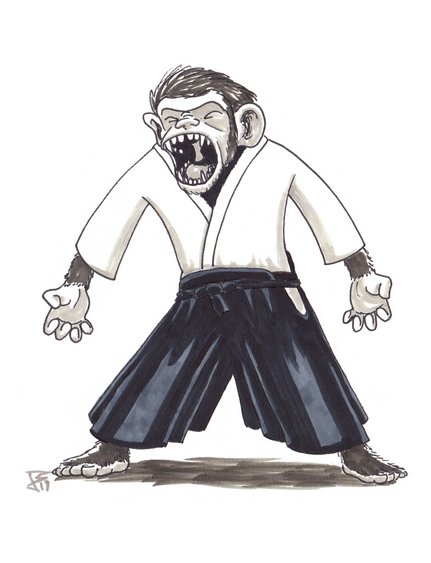
The Shouter
EVERYTHING SHOULD BE DONE WITH KIAI!
BACKSTRETCH! KIAI!
© Jutta Bossert - Used by permission.
|
|
Art. 11
Reflections on my experiences at New England Aikikai
By Christian Morgenstern
Just Aikido, Barcelona, Spain
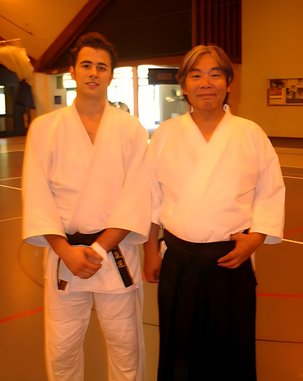
For some time, my dear friend Fiona Blyth sensei encouraged me to write a short reflection on my experiences
at New England Aikikai (NEA). What I quickly realized is that condensing everything into a brief note is nearly
impossible—the flood of memories and the intensity of those years cannot be contained. And frankly, I wasn’t
inclined to shorten them too much, as that time remains among the best in my life, so I hope you will indulge
me as I wander through my recollections.
In 2003 I moved to Boston to attend college, and I was as excited about joining MIT as I was about training at NEA.
I must admit that I had no clue who Kanai Sensei was back then, but everyone I had met had told me that NEA was one
of the best places to train and learn Aikido.
The first day I showed up at NEA, I was full of anticipation. I remember walking down the stairs at the entrance
and taking my first look at the dojo. Since I arrived early, the only other person there was an Asian man standing
behind a counter in the lobby. So I went up to him with youthful joy and anticipation, introduced myself and asked
if I could join the class that day.
His face showed a mix of surprise and disbelief as he looked me in the eyes and said: “NO!” Confused and nervous,
I tried to explain that I had practiced Aikido before, but he shook his head in disbelief, walked past me, and
disappeared without saying a word into what appeared to be an office at the back of the dojo. I stood there baffled
for ten minutes, unsure of what to do next.
Thankfully, Fiona arrived shortly afterward. Though we didn’t know each other personally, she had been acquainted
with friends in Barcelona and I had contacted her before visiting NEA. When I explained what had just happened,
her face went pale with concern: “That was Kanai sensei you just spoke to!” she exclaimed. She quickly went into
the office and, after a few tense minutes, returned with good news: the situation had been clarified, and I was
welcome to practice at NEA. My first classes would even be free. Even now, I still get nervous thinking about
that day.
After that, I joined practice at NEA and I experienced one of the most intense and incredible periods of my life.
Practice was passionate and intense and you could tell that everyone on the mat, no matter what their rank, was
giving it their all every single day. Kanai Sensei's Aikido style was so different from what I was used to that
it took time to understand. Taking ukemi for his style of Aikido, which had a Judo-like quality, was
unconventional and challenging at first. After practice, my knees would ache during my walk home, making me
realize that my previous approach would not suffice—I needed to fully adapt to his style if I wanted to survive
the coming months.
It was only after I committed to learning his approach that fellow students began offering tips and guidance
while I struggled with techniques. I ended up transforming my practice completely, from how I took ukemi to
how I performed techniques.
I have always trained with intensity, and at NEA I gravitated toward the first row, close to the Kamiza,
where I could watch Kanai Sensei closely. He often observed in his characteristic “baseball umpire” stance and
sometimes laughed when he liked some particular move. Eventually, after seeing the effort I was putting in and
apparently making some progress, he started giving me some advice —guidance I remember and value to this day.
His charisma and influence over his students were undeniable, and it didn’t take long for me to be inspired by
his strong personality and kind manners, as you could feel that he really cared about his students.
One vivid memory comes from the summer camp in 2003, my first summer camp in America. Being young, I attended
every single class with full intensity, and by the third day, my left wrist was badly swollen. A fellow NEA
student told me: "Sensei knows a lot about anatomy, he needs to take a look at you". So we went up to Sensei’s
room, where he took my arm, put on his glasses and after looking at my wrist for some time he simply said,
“Not broken!” Though I was unsure of the precision of his medical assessment, I was deeply honored that such
an esteemed teacher took the time to care for a young, relatively unknown student from abroad. As it turned out,
his diagnosis was correct.
After a year of intensive training in America, I visited Sensei's office at NEA to say farewell and offer him a
gift—one of his favorite cakes. When I handed it to him, he asked with a serious demeanor whether I had made it
or bought it. When I told him I had bought it I could not help but laugh at the relief on his face. His final
words to me were, “See you in summer camp next year,” and I replied that I was looking forward to it.
On my last day at NEA, just before leaving the dojo, I remember Sharon, Kanai Sensei's wife, telling me, “You
just fit right in.” She was right. In such a short time, NEA shaped me profoundly, both as a practitioner and
as a person. It was a place where I grew, was challenged, and felt at home—a place I will always carry with me.
|
|
Art. 11a
A thank you letter to my Aikido teachers
By Bat-Sheva Koren
Integral Dojo, Tel Aviv, Israel
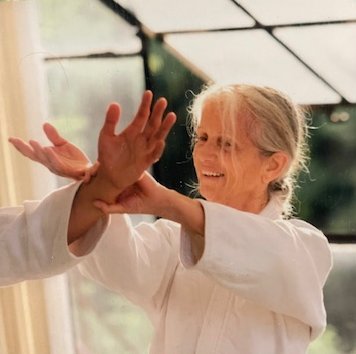
A week before my exam I entered a new realm.
I am invited in silence to listen within… finding myself in stillness in the middle of a spiral. The spiral opens, simultaneously moving in all directions. I am being called …I know I am ready.
In the beginning of the process toward reaching Shodan level I felt as if I was climbing a mountain seeking for the summit, hoping and planning on achieving the goal with hesitation and insecurity. But while practicing intensively, new fields of clarity opened up, surprisingly revealing how simple and similar my journey was to other life experiences, where I am open for a focused aim of the present uniqueness.
A moment before… Miles Sensei is calling me, opening the test space towards Shodan level…
A moment of full concentration yet calling for releasing control…allowing nature to take its course. Aikido's "tribe", including my family members, witnessing one of their own being tested…
Silence … Spirit Presence…
Infinity Expanded as I experienced surrendering in stillness …
"Moved by the Spirit", in the blink of an eye …
Time ends here, NOW…Everyone is smiling…pure happiness. I passed the test, at my level (but what does a level mean?)
I will keep practicing for the next summit. A new horizon clearly opens while it is obvious that nothing is indeed clear for a long time, but a glimpse of a bright moment.
I see Aikido as a spiritual practice. My journey as a student of this practice began in Canada with Sensei Robert Zimmermann (Toronto Aikikai) who guided me at my early developmental stage through the "crawling" stage, as I made my way through excitement, confusion and overwhelm. Upon my return to Israel, I continued my learning with Senseis Miles Kessler, Daniel Herman, Ron Perez (Integral Dojo in Tel Aviv) expanding on the foundation, while refining my skills.
Words aren't enough to express my thanks for helping me capture the essence, the nectar of my experience, with you, my four special teachers. Thanks for your patience in opening the way for discovery, connection and guiding me through the methodology, in a framework of teaching and learning, as a "Breathing Space". A space where a different prism opens for contemplation and for trying new angles and approaches, where suddenly or in a subtle way one may realize: I…SEE. Each of you, my teachers, bring your own different rhythm, style and color of the four winds, of the East, South, West or the North …to ride on together, in creating the potential of experiencing Union with the Way. I am thankful for the differences and uniqueness of each and every one of you.
Another important part of my learning is due to my community members where each and everyone becomes my teacher, in a moment of practice. Those who carry more or less experience. All with such gifts of patience and wisdom to allow me to try without constant correction. Simply letting me Be, reassuring our development (Gil, Eldar, three Itais, Ranny, Shai, Doron Merave, Noam, Michael, Omri, to name a few) and particularly Orly, Eli and Roni, for "Holding and Handling" with careful support, as I prepared for my test. Thank you all.
This training and specific practice is derived from an ancient tradition which I was not born into. However, its echo vibrates strongly, engulfing me in its mystery. The long line of teachers who followed the practice of Aikido as taught by O-Sensei Morihei Ueshiba continues with my teachers who carry the torch of the Past into the open Future of the Present. I found that practice itself is … The Path, not the goal to arrive to, where the stage along the way is but a station, a moment of full clarity until a new reflection emerges with the free ki energy that has taken me into the spiral integration. Re-experiencing kundalini energy, that is moving us all. And now I am ready, in hanmi, to continue.
As I teach and train students in "Authentic Movement" and "Ecstatic Ritual Body Posture" to listen to the Authentic Spirit, here I am practicing Aikido, experiencing and being in the world, as shining infinity, an echo of Spirit manifestation (as I believe each person is). May I add my part toward building an Aikido Spiritual Community?
I would like to extend my thanks and appreciation to all of you, who guided me and showed me the way, and to Sensei Miles Kessler in particular.
In Friendship and Love to you all,
Bat-Sheva
|
|
Art. 12
Dojos granted Full Member status
We are pleased to announce that the following dojos have been granted Full Member status:
- Santiago del Estero Aikikai Dojo, located in the city of Santiago del Estero, Argentina, led by dojo-cho Leandro Ernesto Obligado, godan.
- Kyiv Aikido Club, located in the city of Kyiv, Ukraine, led by dojo-cho Mykola Yemelianov, sandan.
- Samay Dojo, located in the Province of Urubamba, in the Cusco Region, Perú, led by dojo-cho Carola Robles, yondan.
- Dojo Himawari, located in the district of San Miguel, in the city of Lima, Perú, led by dojo-cho Juan Carlos Delgado Velasquez, yondan.
- Aikido Aikikai Yaku Dojo, located in the district of Lince in the city of Lima, Perú, led by dojo-cho Juan Carlos Flores, yondan.
- Kototama Dojo, located in Province of Calca, in the Cusco Region, Perú, led by dojo-cho Jorge Campos, sandan.
- Katsujinken, located in Girona, Spain, led by dojo-cho Javier Raa, yondan.
- Aikido Sakura Dojo, located in the city of Barquisimeto, in the state of Lara, Venezuela, led by dojo-cho Angel González, sandan.
- Asahikan Dojo, located in the city of Collegeville, in the state of Pennsylvania, USA, led by dojo-cho Michael Aloia, godan.
A warm welcome to all!
|
|
Art. 13
Introducing Asahikan Dojo
By Michael Aloia
Dojo-cho Asahikan Dojo, Collegeville, PA
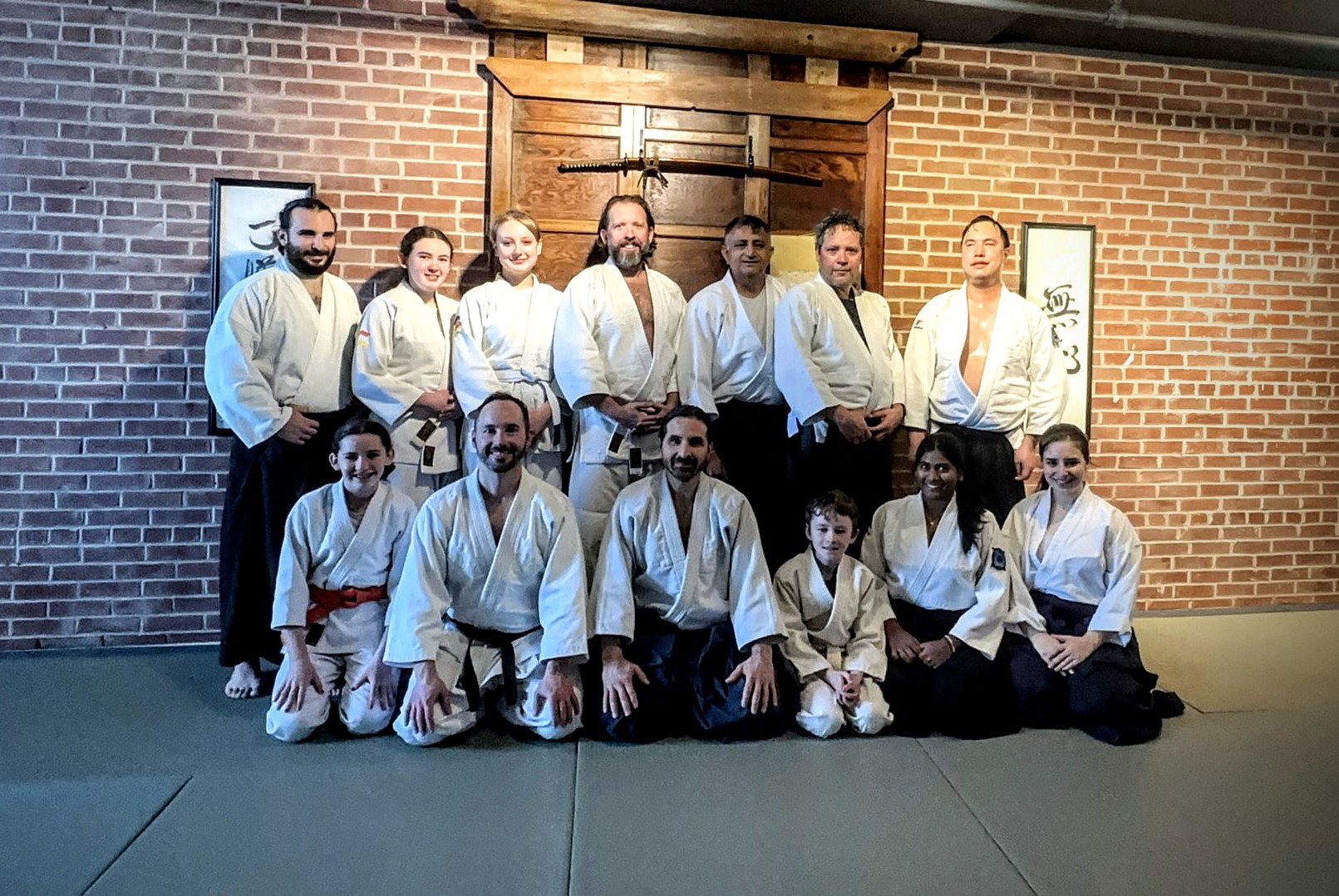
I began my personal study of Aikido in my mid-20s. Coming from Karate and Judo, Aikido seemed like the most logical
progression, one with a level of sophistication that opted for thoughtful presence of mind, body, and spirit rather
than raw aggression, brutal conflicts or excessive muscle. Fast forward 30 years later, and Aikido still stands to
me as the most logical progression to achieving a sophisticated approach to turmoil, chaos, and confrontation.
My name is Michael Aloia. I am an instructor at Asahikan Dojo, located in Collegeville, PA. Our dojo recently
celebrated its 25th year as part of the local community, offering a martial arts cultural experience to those in our
area. During that time, we have witnessed many changes both within our ranks as a dojo as well as changes throughout
our collective neighborhoods. A lot is different, but so much is still the same. Our 25th year also had us relocating
our training space unexpectedly. However, our Aikido training had proven itself valuable as our membership weathered
the storm, working together to move, renovate, and maintain classes during the relocation. Such a coming together was
a testament to the levels of effect Aikido can have on a community or an individual who walks its path.
The saying, "fall down seven times, get up eight," has no truer meaning, no greater ripple than that of a community
coming together for something with a higher purpose. With all the negativity that often surrounds Aikido from its
critics and detractors, the art still finds a way of tempering the hard times by smoothing the rough edges and polishing
the blade simultaneously. Such a tempered mindset continues to serve as our dojo's goal and purpose.
Asahikan Dojo is excited and honored to have been accepted as a new member of Shin Kaze Aikido Alliance. Such an
affiliation serves as a link to something larger than oneself but also as a touchstone to a vast legacy of exploration
and discovery in the pursuit of betterment. We look forward to building on this relationship and connecting with the
larger Aikido community of Shin Kaze.
|
|
Art. 14
Art. 15
Art. 16
Art. 17
Art. 18
Art. 19
Art. 20
Dear Dojo-cho and Supporters:
Please distribute this newsletter to your dojo members, friends and anyone interested in
Shin Kaze Aikido Alliance.
If you would like to receive this newsletter directly, click
here.
|
|
|

|
SUGGESTION BOX
Do you have a great idea or suggestion?
We want to hear all about it!
Click
here
to send it to us.
|
Donations
In these difficult times and as a nonprofit organization, Shin Kaze welcomes donations to support
its programs and further its mission.
Please donate here:
https://shinkazeaikidoalliance.com/support/
We would also like to mention that we accept gifts of stock as well as bequests to help us build
our Shin Kaze Aikido Alliance endowment.
Thank you for your support!
|
|
|
|
|
|